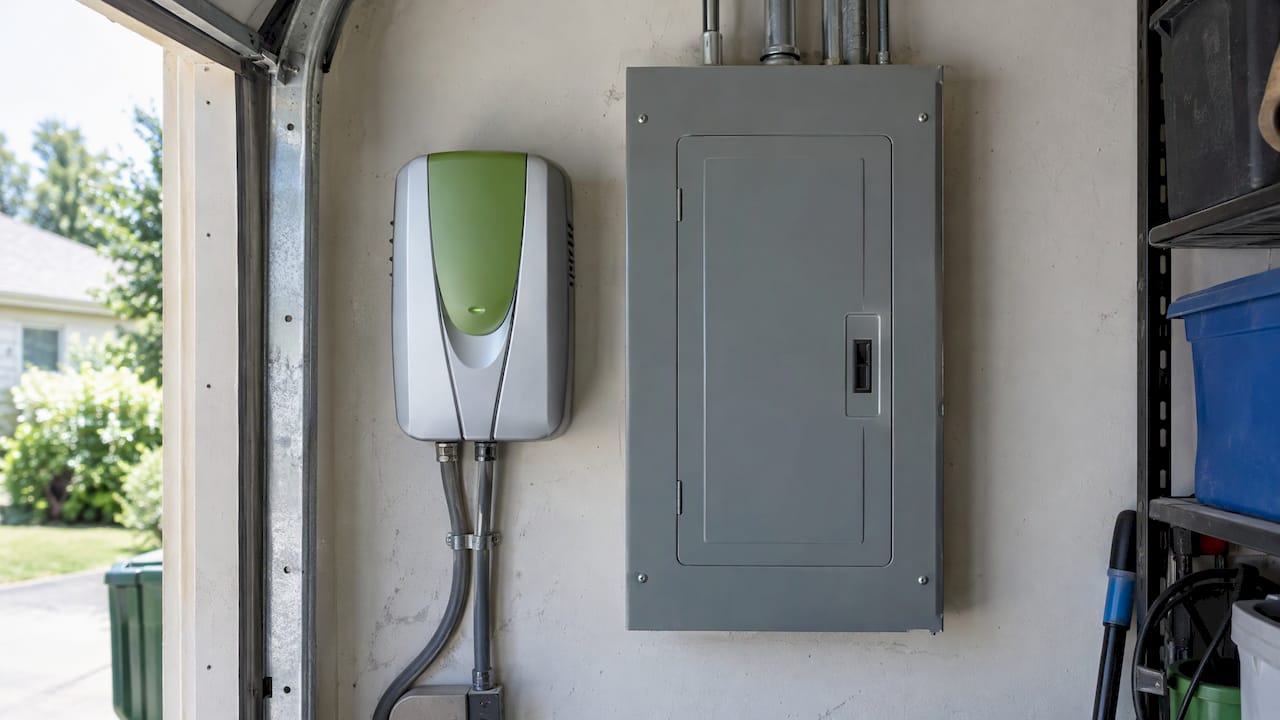
A residential energy saver is a device that connects to your property’s electrical supply to optimize how power is used, so less is wasted and your equipment is better protected. The Electric Saver 1200 is built for that job: our design recycles unused energy and feeds it back into the home or business, aims to save up to 25% on energy costs, and adds whole-property surge protection in the same unit. This guide explains how these devices work, what to look for, and how to pair one with habits that lower a bill.
TL;DR
- A residential energy saver works on how electricity is delivered and used (power factor, wasted current, surges), not on how much you switch off.
- The Electric Saver 1200 combines energy savings with whole-property surge protection, which also protects appliances.
- Check four things before buying: safety listing, voltage and phase compatibility, solar compatibility, and warranty length.
- Efficiency basics such as lighting, sealing and standby control stack with a device and raise the total.
- Residential and commercial models exist, so a home and a shop can each get the right fit.
Table of Contents
- What a residential energy saver is
- Power factor in plain words
- What a whole-property device does for you
- What to check before you buy
- Why businesses look at power factor first
- Pair the device with proven efficiency basics
- Installing a residential energy saver
- Who gets the most from one
- Get the Electric Saver 1200 for your property
- FAQ
- Sources
What a residential energy saver is
Searches for this topic use many names: home energy saving device, electricity control device, electricity optimizer, energy control device, home power optimizer, whole home energy saver, or home voltage optimizer. They all point at one idea. Instead of asking you to change your routine, a small unit on your electrical supply works on the quality and efficiency of the power your appliances receive.
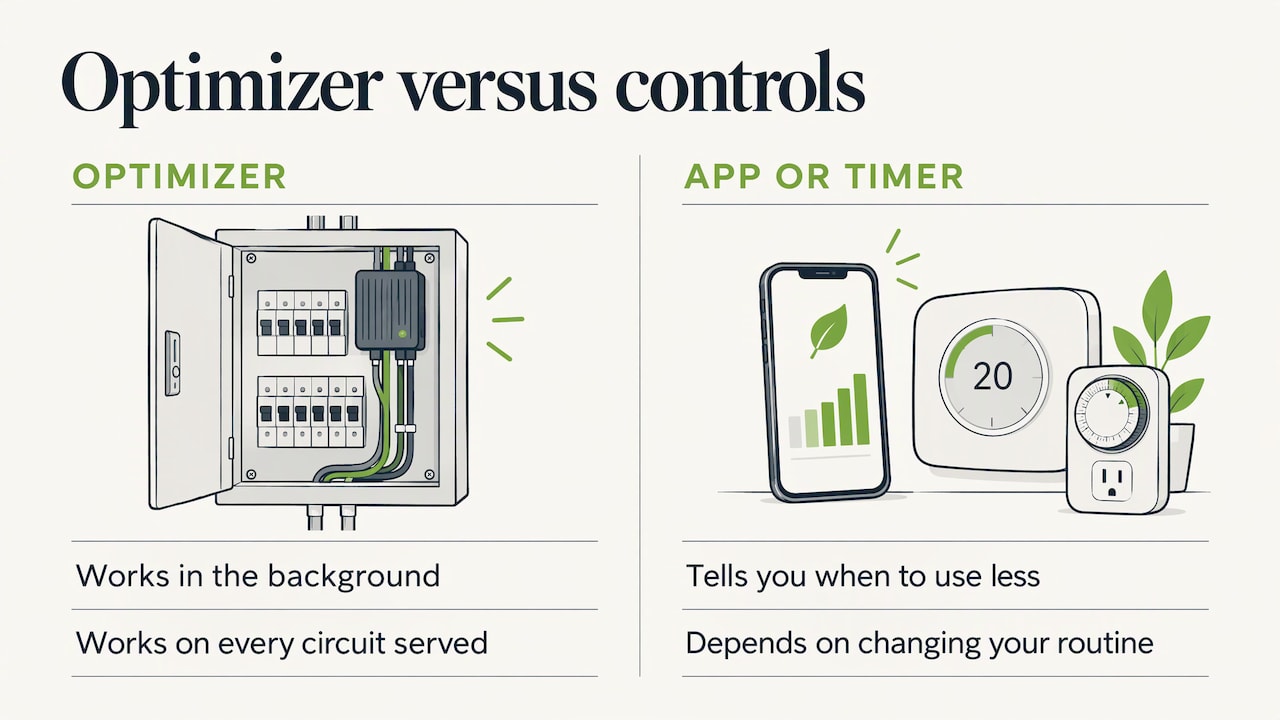
That is different from an app, a smart thermostat or a timer. Those tell you when to use less. An optimizer works in the background on every circuit it serves, whether you are home or not.
The Electric Saver 1200 follows this approach. Our owner-stated aims are lower monthly electricity costs, longer appliance life and surge protection for the whole property. It comes in residential and commercial versions, with models for single-phase and three-phase systems.
Power factor in plain words
Most of the technical talk around these devices comes down to power factor. Here is the short version.
Your appliances need two kinds of power. Real power does the work: it spins the motor, heats the element, lights the lamp. Reactive power is the supporting cast: motors, compressors and transformers need it to build the magnetic fields they run on, but it does no work itself. Together they make up apparent power, which is what the wiring has to carry.
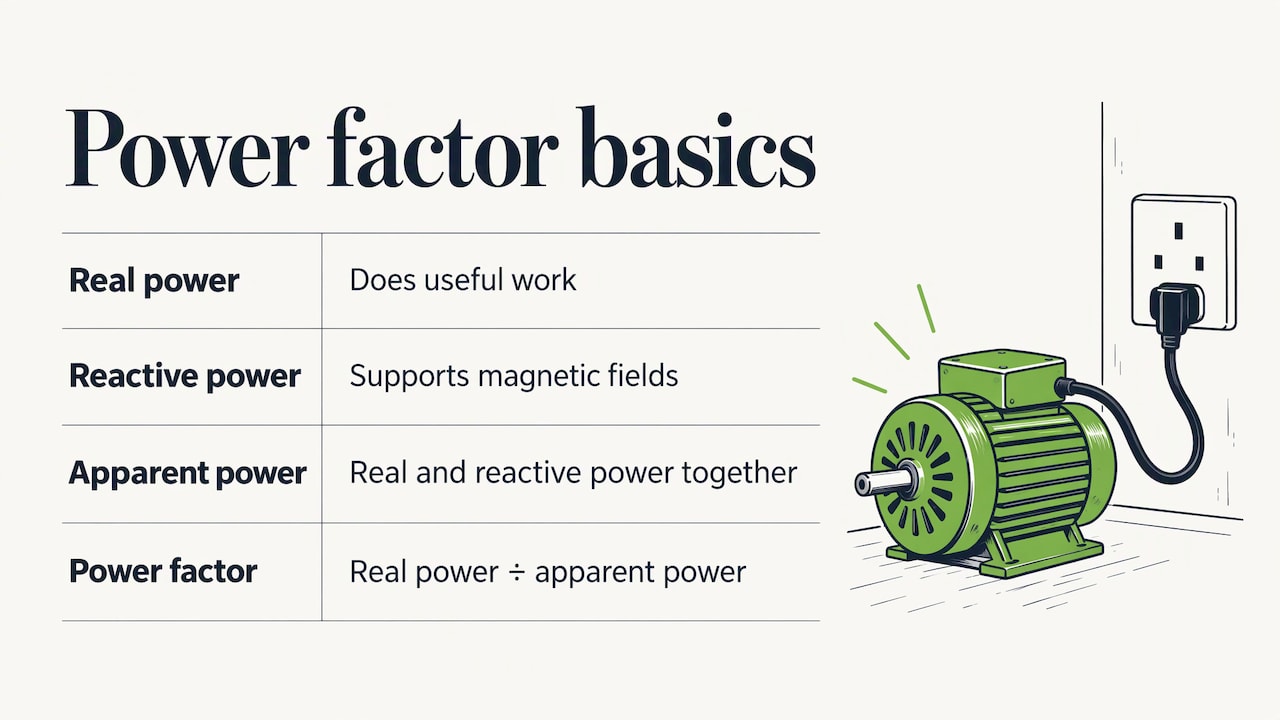
Power factor is the ratio of real power to apparent power:
Power factor = real power (kW) ÷ apparent power (kVA)
A power factor of 1.0 means every amp in the wire does useful work. A lower number means the wiring carries extra current that does not. Correction equipment typically uses capacitors to supply reactive power locally, which reduces the current flowing in the supply lines. Less current means less strain on conductors, breakers and the equipment on the circuit.
A household full of air conditioners, refrigerators, pumps and washers is, electrically, a collection of motors. That is why power factor is a natural target for a whole-home device.
What a whole-property device does for you
The Electric Saver 1200 does three things at once, and the combination is the reason people choose it over single-purpose gear.
1. It targets your electricity costs
Our units are designed to reduce monthly electricity costs by up to 25%. The device recycles energy that would otherwise go unused and feeds it back into the property, optimizing how it is used.
What you save depends on your own mix of loads. Homes with many motor-driven appliances, such as heat pumps, well pumps, pool pumps, freezers and workshop tools, give a device more to work with than a home that runs mostly electronics and lighting. Commercial buildings with large motor loads, such as HVAC, refrigeration and machinery, are the strongest fit, which is why a three-phase commercial line exists.
2. It protects the property from surges
A power surge is a brief spike of voltage that can stress or destroy electronics. Utilities note that transient surge protection is valuable for protecting equipment. The Electric Saver 1200 provides whole-property surge protection, so the protection covers the circuits in the building rather than only what you plug into a power strip.
If you want the detail behind surge ratings, our guides on how a surge protector works, how many joules of protection you need and whole-house surge protection go deeper.
3. It supports longer appliance life
Heat and electrical stress wear out motors and electronics. Lower current on the circuit and a buffer against spikes are both aimed at reducing that stress. Appliance longevity is a design goal of the Electric Saver 1200, and it is the benefit people often notice last, when a refrigerator or compressor keeps running long past the point they expected to replace it.
What to check before you buy
Whether you are comparing models from us or reading any product page, the same checklist applies.
| What to check | Why it matters | Electric Saver 1200 |
|---|---|---|
| Safety listing | Shows the device was tested for safe use | UL and CuL listed |
| Voltage range | The unit must match your supply | Compatible with household or business voltage up to 480V |
| Single or three phase | Homes are usually single-phase, many businesses are three-phase | Models for both |
| Solar panels | Your system should work alongside your array | Compatible with properties that have solar |
| Warranty | Shows the maker’s confidence over the long run | 20-year warranty |
| Origin and shipping | Affects support and delivery time | Made in the USA, fast shipping on all orders |
What a UL mark tells you
A UL listing means the device was evaluated as safe for its listed use. A specific standard, such as UL 1449 for surge protection, identifies which type of protection was tested. When you read a product page, look for the named listing and the named standard, not just a logo. The Electric Saver 1200 carries UL and CuL listings, and our devices have also been verified by NASA, as well as GE, for safety and effectiveness.
Safety approval matters for any electrical product, from a home charger to a whole-home device, because poorly approved equipment can create shock or fire hazards. This is the same reasoning behind the electrical safety approval that governs high-amp home charging circuits: the higher the load, the more the listing counts.
Matching the model to the property
- Single-family home on single-phase service: the residential Electric Saver 1200 is the model to look at.
- Home with solar panels: our devices are compatible with solar properties.
- Shop, restaurant, warehouse, office or industrial site on three-phase power: the commercial range covers these, including power factor correction products priced from $1,499.95 to $1,999.95 one-time.
- Electrician or reseller: bulk and dealer orders are available, and you can become a dealer.
Why businesses look at power factor first
For a home, power factor is about efficiency and equipment stress. For a business, it can also be a billing matter. Utilities generally bill poor power factor to large commercial and industrial customers, so a building with big motors, compressors or machinery has a direct reason to correct it.
If you run a commercial property, start with your utility bill and look for a power factor line, a kVA or demand charge, or a penalty. Our commercial energy efficiency guide walks through ways to cut building energy costs, and the three-phase commercial devices are built for these sites. If you want to see what over-correction means and how correction is sized, read our explainer on power factor correction.
Pair the device with proven efficiency basics
A device that works on the electrical side of your building is strongest when you also cut the actual demand. Government research shows which basics pay off.
- Lighting. In a Florida field study of 56 homes hosted by the U.S. Department of Energy, shallow retrofits saved an average 9%, or 4.2 kWh a day. Lighting retrofits alone saved 17% on average, and the average total retrofit cost was $374 against $184 in annual energy-cost savings.
- Standby loads. The National Renewable Energy Laboratory reports that advanced power strips with current sensing can cut power to controlled outlets when devices are off, eliminating their standby draw.
- Air sealing and insulation. In the Department of Energy’s weatherization evaluation, air sealing accounted for 28% of natural-gas savings and attic insulation for 24% in single-family homes.
- Efficient cooling. An Oak Ridge National Laboratory field test in Tulsa found that replacing one low-efficiency window air conditioner saved 535 kWh a year, and more in homes with heavy use.
- The building envelope. Better glazing cuts heat gain and loss, which is why energy-efficient window upgrades are part of many efficiency plans.
These measures reduce how much energy the building asks for. A residential energy saver improves how that energy is delivered and used, and protects the equipment that uses it. Together they cover both sides. For a longer list of appliance-level choices, see our guide to what impacts your power bill the most and our page on ways to save electricity at home.
A worked example
Take a household with a monthly bill of $200. If a device delivered the up to 25% we design for, the top-end saving would be $50 a month, or $600 a year. Your result depends on your appliance mix, your usage and your utility rates, so treat the figure as the ceiling of our design target and compare it against your own statements over several months. A home with many motors and long run times sits closer to that ceiling than a home that is mostly electronics.
How to read the result: record your kWh use (not just the dollar amount) for the same months before and after installation, since rates and weather change the dollars. Compare the same season year over year when you can.
Installing a residential energy saver
The Electric Saver 1200 is designed for easy installation. Because it connects to your electrical supply, a licensed electrician should handle the connection, and electricians and dealers are among the customers we serve with bulk orders.
- Confirm your service. Check whether you have single-phase or three-phase service and note your voltage. Our devices handle voltages up to 480V.
- Choose the model. Pick the residential unit or a commercial product that matches your phase and load.
- Order. Place the order online. We ship fast on all orders.
- Have it installed. Our installation guide shows what the process looks like, so you and your electrician know what to expect.
- Track your bills. Keep your monthly kWh figures so you can see the change on your own meter.
Who gets the most from one
- Homeowners with high bills and many motor-driven appliances.
- Owners of expensive electronics and appliances who want a layer of whole-property surge protection and gentler operating conditions.
- Solar households who want a device compatible with their array.
- Small businesses and commercial sites with motors, compressors or refrigeration.
- Environmentally conscious owners who want to waste less of the power they already pay for.
Our perspective
We build the Electric Saver 1200 around one conviction: a bill is not only about how much you use, it is also about how well the power you pay for is used. Most efficiency advice stops at behavior, and behavior matters. But a property with motors, compressors and sensitive electronics also benefits from equipment that works on the electrical side, around the clock, without asking anyone to remember anything.
That is why we put energy savings and whole-property surge protection into one device. You get a unit aimed at up to 25% lower energy costs, protection for the appliances you have paid for, and a 20-year warranty. It is UL and CuL listed, verified by NASA, made in the USA, and compatible with voltages up to 480V and with solar properties.
Use it alongside lighting upgrades, sealing and smart standby control, and you attack the bill from both directions.
Jonica
Get the Electric Saver 1200 for your property
If you are ready to put a residential energy saver to work, the Residential Electric Saver 1200 is the unit for single-family homes, with fast shipping and a 20-year warranty. Business owners can look at our power factor correction products for three-phase and commercial sites. You can also start from our main page to compare the range.
We are confident you will like what a cleaner, better protected electrical system does for your property. Order today and start tracking the difference on your next bill.
FAQ
What is the difference between an energy saver and a surge protector?
A surge protector limits brief voltage spikes to protect equipment. An energy saver works to optimize how power is used so your costs come down. The Electric Saver 1200 combines both functions, giving whole-property surge protection and energy savings in one device.
Does a residential energy saver work with solar panels?
Yes. Our devices are compatible with properties that have solar panels, and with any household or business voltage up to 480V. Tell us about your system when you order so you pick the right model.
How much can I save with the Electric Saver 1200?
We design the Electric Saver 1200 to reduce energy costs by up to 25%. Your own savings depend on your appliances, how much they run and your utility rates. Track your kWh use before and after installation to see your result.
Is a residential or commercial model right for me?
Single-family homes on single-phase service use the residential Electric Saver 1200. Businesses and larger properties, especially those on three-phase service or with large motor loads, should look at the commercial power factor correction products, which range from $1,499.95 to $1,999.95 one-time.
Sources
- Domestic Energy Saving Devices, Power Quality Australia technical note
- JEA, Consumers Beware
- UL 1449, Standard for Surge Protective Devices
- Building America Case Study: Pilot Demonstration of Phased Retrofits
- Managing Plug Loads With Advanced Power Strips
- Findings from the Retrospective Evaluation of the U.S. Weatherization Assistance Program
- The Oklahoma Field Test: Air-Conditioning Electricity