
Peak electricity demand is the moment your area, your home or your building draws power at its highest rate. It matters because utilities build and price their systems around that moment. Depending on your rate plan, it can raise what you pay per kilowatt-hour, add a separate demand charge, or both. The way to lower its cost is to use less power during peak hours, move flexible loads to off-peak hours, and cut waste across the property all day. Whole-property devices like the Electric Saver 1200, built for residential and commercial buildings, work on the second half of that problem: they are designed to lower the electricity bill itself while protecting your equipment.
TL;DR
- Consumption (kWh) is how much energy you use over time. Demand (kW) is how fast you use it at one moment. Peak demand is the highest such moment.
- In most of the U.S., summer peaks land in the late afternoon and early evening, and many time-of-use plans price weekday 4 to 9 p.m. highest.
- Businesses often pay a demand charge based on their single highest 15-minute reading in a billing cycle. One spike can set the charge.
- Shifting dishwashers, laundry, EV charging and pre-cooling away from peak hours lowers cost. Cutting always-on waste lowers it further.
- We build whole-property energy-saving and surge-protection devices in the USA for homes and businesses, with a 20-year warranty.
Table of Contents
- Peak demand versus consumption: the difference on your bill
- When peak electricity demand happens
- Why peak demand costs more
- How utilities charge for it
- What to avoid during peak hours
- A step-by-step plan to lower your peak costs
- What peak demand means for businesses
- Where the Electric Saver 1200 fits
- FAQ
- Sources
Peak demand versus consumption: the difference on your bill
Two numbers describe your electricity use, and they are easy to confuse. According to San Diego Gas & Electric, consumption, measured in kilowatt-hours (kWh), is the amount of energy used over a period. Demand, measured in kilowatts (kW), is the rate at which you use electricity at a given point in time. Peak demand is the highest of those readings, for example the highest 15-minute interval in a billing cycle.
A simple comparison helps. Running a 1 kW space heater for one hour uses 1 kWh. Switching on that heater, an oven, a dryer and an air conditioner at the same time pushes your demand much higher, even if each runs only briefly. Your kWh total may barely change, but your peak reading jumps.
That same utility notes that bills can be based on how much you use, when you use it, and, for some customers, how much you use at any one time. Which of these applies to you depends on your rate plan, so the first step is to read the rate schedule on your bill. Our guide to watts, kilowatts and understanding your electric bill walks through the basic units.
When peak electricity demand happens
There is no single peak hour. It depends on weather, season and what equipment people use.
The U.S. Energy Information Administration reports that U.S. hourly load is generally highest in summer, peaking around 5 to 6 p.m. as air conditioning runs. Air conditioning is used in 87% of U.S. homes. Winter load tends to show a morning peak and an evening peak instead, and spring and autumn are the quietest seasons.
Regions differ too. The Bonneville Power Administration points out that definitions of system peak vary widely across North America. PJM, a large grid operator in the eastern U.S., defines its peak period as non-holiday weekdays from 2 to 6 p.m. in June through September. BPA’s system in the Pacific Northwest peaks in winter, when cold weather drives heating. Texas follows its own pattern: ERCOT says peak demand typically falls in the late afternoon into evening in summer, and in the morning and evening in winter.
The practical takeaway: your utility’s published peak window is the one that counts for your bill, and it may differ from the grid’s actual busiest hour.
Why peak demand costs more
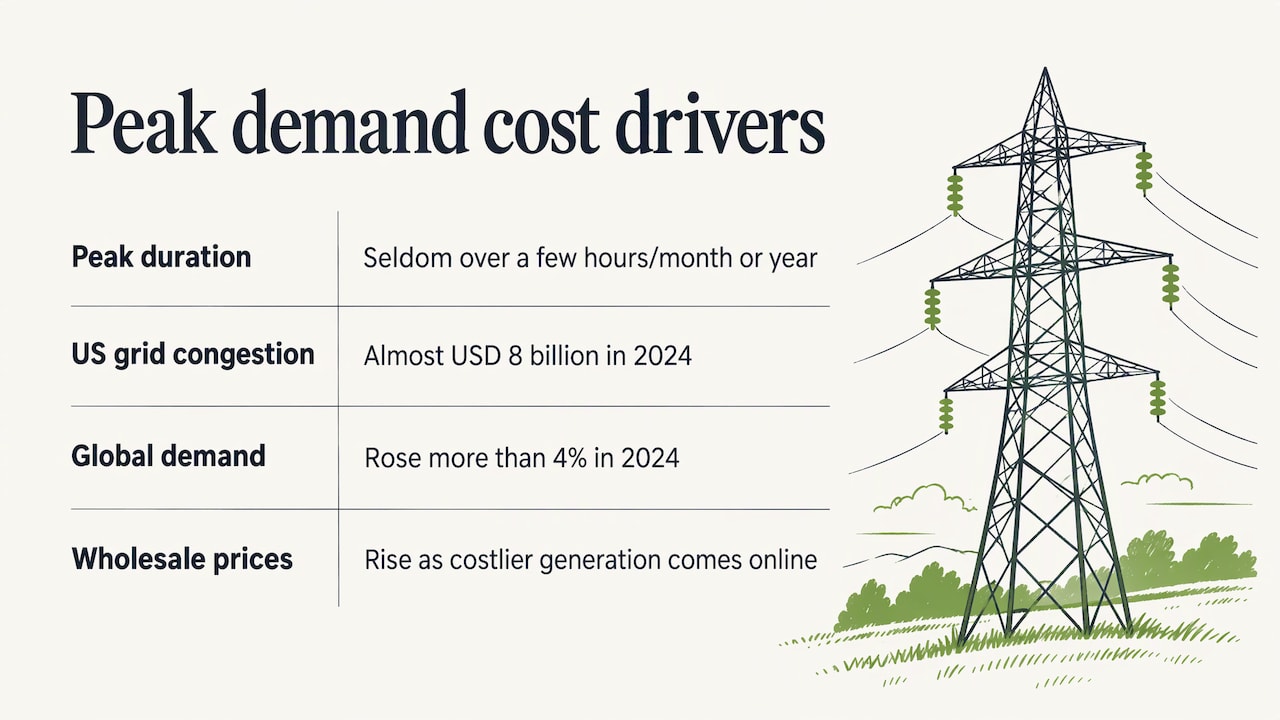
The grid must be able to serve the highest moment, even if that moment lasts only a few hours a year. The U.S. Forest Service explains that peak demand seldom lasts more than a few hours each month or year, yet utilities must maintain generating and transmission capacity for it. Those capacity costs end up in rates.
EWEB, a public utility in Oregon, says that peak electricity is more expensive, raising wholesale power and infrastructure costs and ultimately customer bills. It adds that supplying power at peak times increases greenhouse gas emissions. The EIA adds that wholesale prices generally rise as more expensive generation is brought online.
The scale is large. The IEA reports that grid congestion cost almost USD 8 billion in the United States in 2024, and that global electricity demand rose more than 4% that year. For a closer look at how peak load connects to grid costs and system planning, see this explainer on baseload versus peak load metrics.
Massachusetts regulators make the same point about rate design. Their time-of-use rate proposal says that flat per-kWh rates hide peak demand, the main driver of system costs. Customers who use power flexibly end up subsidizing those with pronounced peaks.
How utilities charge for it
There are two main mechanisms. You may be on one, both or neither.
Time-of-use rates
Time-of-use (TOU) plans charge different prices per kWh at different times of day. Consumer-focused guidance from EnergySage says that for most U.S. utilities on these plans, electricity is cheapest from roughly 9 p.m. to 6 a.m., and peak hours usually fall on weekdays between 4 and 9 p.m. California’s three big investor-owned utilities use weekday 4 to 9 p.m. peak windows.
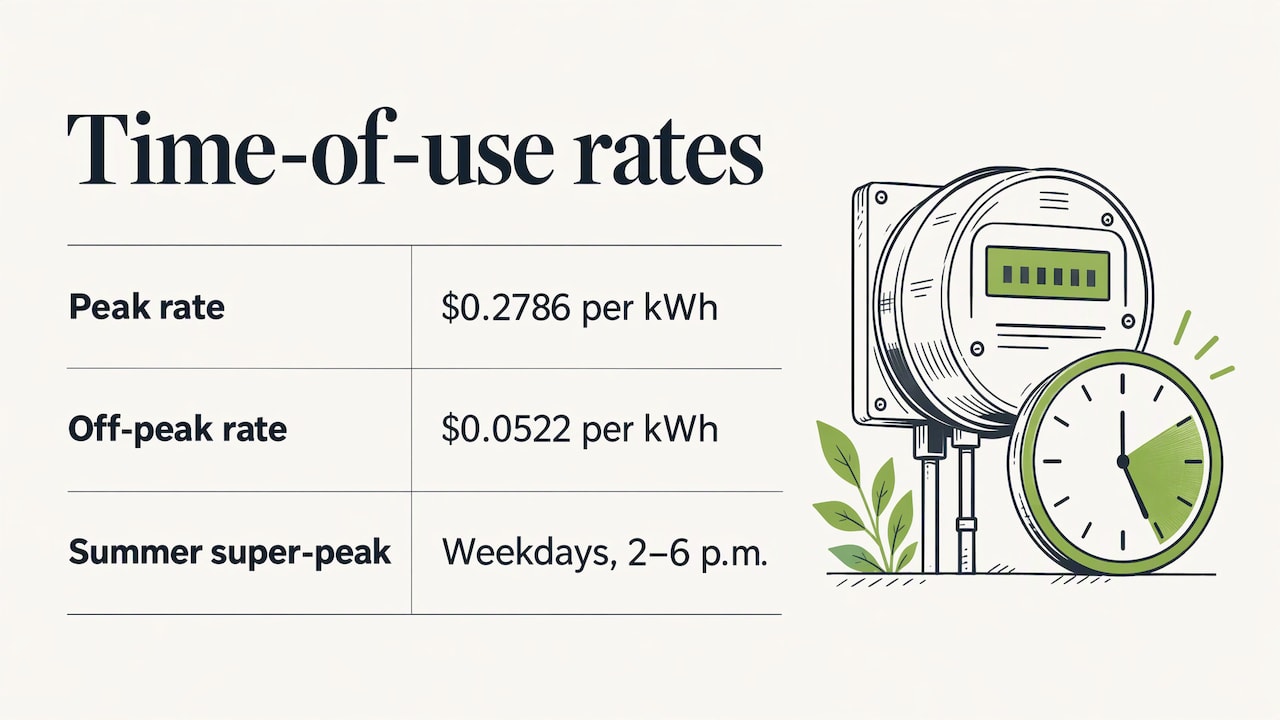
The gap can be large. Con Edison’s residential schedule lists $0.2786 per kWh at peak and $0.0522 per kWh off-peak, with a summer super-peak on weekdays from 2 to 6 p.m. Those are that utility’s published rates for its summer schedule, and they change when rate cases are decided, so check your own utility’s current tariff.
Does it work? A Ghent University working paper using Belgian household data found that peak-based charges reduced monthly household peak demand by 50 to 120 watts, and that EV owners shifted up to 0.75 kWh per day to nighttime hours. In a UK trial, 20,000 households moving from flat to time-of-use tariffs cut the share of daily demand in the 4 to 7 p.m. peak by 15% to 17%, and the effect lasted at least six months.
Demand charges
Demand charges are more common for commercial customers. San Diego Gas & Electric explains that its non-coincident demand charge is based on the higher of maximum monthly demand or 50% of maximum annual demand in any 15-minute interval, while on-peak charges apply to the highest 15-minute kW demand during on-peak periods. Rochester Public Utilities applies demand charges to commercial customers with demand over 25 kW, measured in 15-minute intervals, and bills other commercial customers on consumption.
Here is a worked example with a made-up rate. Suppose your utility charges $20 per kW of monthly peak demand. If your highest 15-minute reading in the month is 40 kW, the demand charge is $800, whether that reading happened once or a hundred times. Cutting that single spike to 32 kW takes $160 off the bill. This is why a start-up surge from several large motors at once can cost more than hours of steady running. Our page on business electricity costs covers the other pieces of a commercial bill.
What to avoid during peak hours
The appliances that matter are the ones that draw the most power and can wait. ENERGY STAR recommends pre-cooling your home during off-peak hours and using a smart thermostat to raise the setting while you are away in summer. As a rule of thumb, it says, after 9 p.m. and before 9 a.m. is off-peak in most situations.
In practice, during your utility’s peak window, try to hold off on:
- Electric dryers and washing machines
- Dishwashers
- Ovens and other large cooking loads
- EV charging
- Electric water heating, where a timer can shift it
- Pool pumps, which you can often reschedule (see our note on inefficient pool pump motors)
ERCOT’s conservation requests ask residents to postpone large appliances such as washers, dryers and dishwashers, and Texans’ voluntary conservation has cut use by about 500 MW each time over the last two years.
Two safety notes. The UK Centre for Sustainable Energy advises against running washing machines, tumble dryers or dishwashers overnight because of unnoticed leak or fire risk, so a delay timer that starts a cycle when you are still awake is safer. It also says not to switch off your fridge or freezer, since they use very little electricity.
A step-by-step plan to lower your peak costs
- Find your rate structure. Check your bill or your utility’s website for time-of-use periods or a demand charge. Note the exact peak window and, for business accounts, the demand interval (often 15 minutes).
- Look at your interval data. Many smart meters show usage by hour or by 15 minutes through the utility’s online portal. Find when your own peak happens and what was running.
- Shift what is flexible. Use timers, smart plugs or appliance delay-start. EWEB suggests running the dishwasher, laundry and EV charging after 9 p.m. For the cleanest power on its grid, it suggests charging EVs between 10 p.m. and 6 a.m.
- Stagger large equipment. In a business, start motors, compressors and heaters in sequence rather than together so the 15-minute reading does not spike. The Forest Service guide also recommends rescheduling energy-intensive operations such as night irrigation and timer-controlled water heaters.
- Cut the loads you cannot move. Lighting, refrigeration and standby loads run through the peak. The UK government’s Powering the Nation 2 study concluded that improving the efficiency of non-switchable appliances makes a bigger difference to peak load than load-shifting. The same study found switchable appliances made up about 9% of household peak load.
- Reduce standby draw. Lawrence Berkeley National Laboratory says standby power is typically 5 to 10% of residential electricity use in most developed countries. Power strips with a switch help.
- Treat the whole property. Once the schedule is tuned, add a device that works on the electrical system itself. That is where we come in, covered below.
More household ideas are in our list of ways to conserve electricity and our guide to which appliances affect your power bill the most. If your bill jumped and you do not know why, start with why your electricity bill is high.
What peak demand means for businesses
For a business, the peak reading is a budget line. A short overlap of equipment can set a charge that applies for the whole billing cycle, and in some tariffs the annual maximum also sets a floor, as in the SDG&E rule above. The most useful habits are the same ones as at home, scaled up: know your interval, stagger starts, and remove constant waste.
Our page on commercial energy efficiency covers building-wide approaches, and how to lower power bills and kilowatt usage covers both home and business.
Our view on peak demand
Most advice on peak demand stops at schedules: run the dryer later, charge the car at night. That is good advice, and it works. But it leaves two things untouched. The first is the load you cannot move, such as the refrigerator, the lighting, the motors that have to run when the business is open. The second is the quality of the power those loads receive.
That is the problem the Electric Saver 1200 was built around. It recycles energy and feeds it back into the home or business, which is designed to optimize how electricity is used, and our customers can save up to 25% on energy costs. It does this for the whole property at once, so the savings do not depend on remembering to flip a switch at 4 p.m.
We also think about the equipment on the other side of the meter. The same unit provides surge protection for the whole property, and it is designed to extend the life of appliances. It is UL and CuL listed, verified for safety and effectiveness by UL, GE and NASA, and made in the USA. It works with any household or business voltage up to 480V, including properties with solar panels, and we stand behind it with a 20-year warranty.
Use the schedule. Then let the device do the part a schedule cannot.
Jonica
Where the Electric Saver 1200 fits
Once you have moved what you can move, the loads that remain still cost money every hour. Our Electric Saver 1200 is designed to reduce electricity bills, extend appliance life and protect the whole property from surges. Residential and commercial units are available, with models for single-phase and three-phase systems, and installation is designed to be easy. Our installation guide explains the process, and the breaker sizing page helps you choose the right size.

Homeowners can see the Residential Electric Saver 1200. Businesses can look at our Power Factor Correction Products, priced at $1,499.95 to $1,999.95 one-off. Dealers and electricians can ask about bulk and wholesale orders. All orders ship fast.
FAQ
What is the cheapest time to use electricity?
On most U.S. time-of-use plans it is late at night and early morning, typically 9 p.m. to 6 a.m. Peak hours usually fall on weekdays between 4 and 9 p.m. Your utility’s rate schedule is the final word, because windows differ by company and season.
What should I not use during peak hours?
Hold off on large, flexible loads: dryers, dishwashers, washing machines, ovens, EV charging and electric water heating. Pre-cooling your home before the peak window and raising the thermostat setting during it also helps, as ENERGY STAR advises. Keep the fridge and freezer running.
Is peak demand the same as peak hours?
Not exactly. Peak hours are the time window your utility prices higher. Peak demand is the highest rate of use you or the grid actually reach, measured in kW. On a demand-charge plan, your own highest 15-minute reading can set a charge no matter what time of day it happens, depending on the tariff.
Why is peak demand worse in summer in some places and winter in others?
It follows the weather. Where air conditioning dominates, as across much of the U.S., load peaks in summer afternoons and early evenings. Where electric heating is common, as in the Pacific Northwest, cold mornings and evenings set the highest load.
Sources
- San Diego Gas & Electric: Understanding Demand
- EIA: Hourly electricity consumption varies throughout the day
- EIA: Electricity demand changes in predictable patterns
- Bonneville Power Administration: Estimating Peak Demand Impacts
- ERCOT: Energy Conservation
- U.S. Forest Service: Understanding Demand Charges
- EWEB: Understanding Peak Power
- IEA: The Value of Demand Flexibility
- Massachusetts DOER: Time-of-Use Rate Proposal
- EnergySage: Off-Peak Electricity Hours
- Con Edison: Time-Of-Use Rates
- Ghent University working paper on peak demand charges
- NESO: CrowdFlex Phase 1 Report
- Rochester Public Utilities: Understanding Demand and Energy
- ENERGY STAR: How To Save Electricity During Peak Demand Conditions
- Centre for Sustainable Energy: Demand Flexibility Service
- Powering the Nation 2 (UK government)
- Lawrence Berkeley National Laboratory: Standby Power FAQ