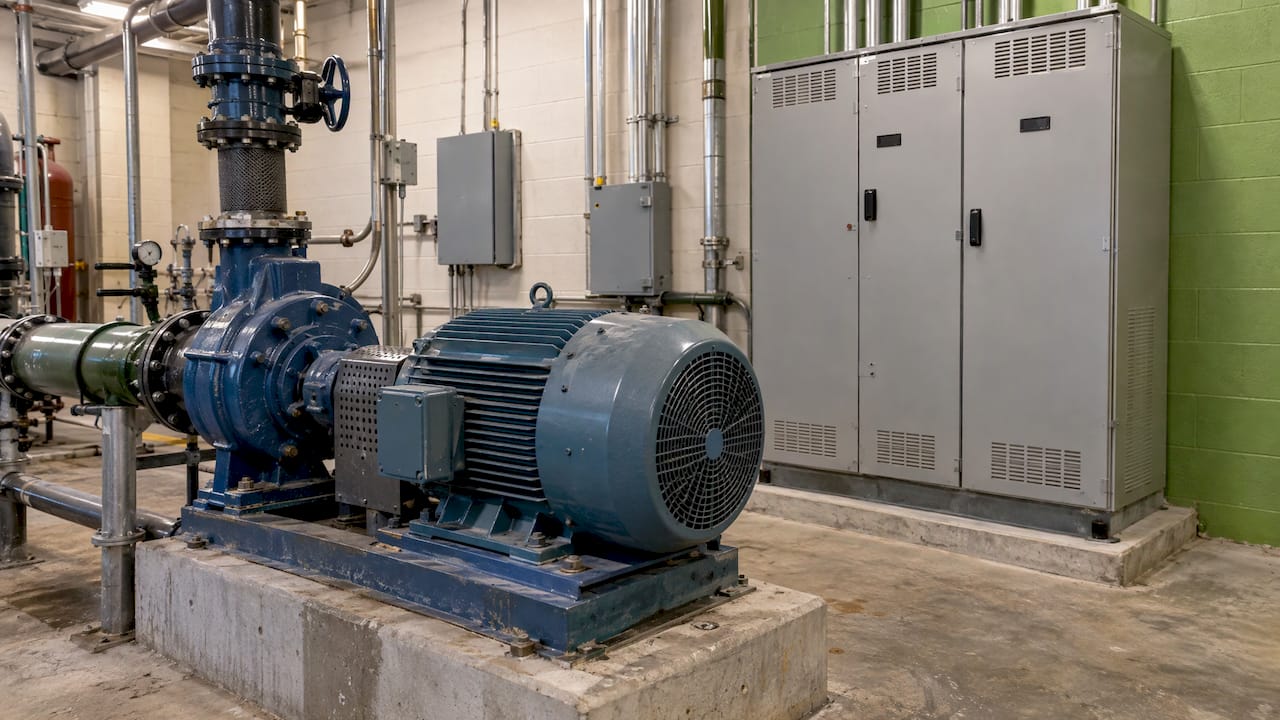
Reactive power is the part of AC electricity that moves back and forth between the source and your equipment without doing useful work. Motors, transformers and similar loads need it to build their magnetic fields, but you never use it up the way you use the watts that turn a shaft or light a lamp. It still travels through your wiring, so it adds current, heat and load. That is why power factor, the measure of how much of your current does real work, matters to anyone who wants lower bills and longer-lasting appliances.
TL;DR
- Real power (watts) does the work. Reactive power (VAR) supports the magnetic and electric fields that motors and transformers need, and it returns to the source instead of being consumed.
- Apparent power (VA) is the combination of both. Power factor is real power divided by apparent power, so a lower number means more wasted current.
- Inductive loads such as motors, transformers and high-intensity discharge lighting create most reactive demand. Capacitors supply it locally.
- Large commercial customers can be billed for low power factor, and correcting it is a standard, documented practice.
- Our Electric Saver 1200 line is built for power factor correction in homes and businesses.
Table of Contents
- What reactive power means
- Real, reactive and apparent power
- Real power vs. reactive power: the difference
- Where reactive power goes
- What creates reactive power
- Why reactive power affects equipment and costs
- How reactive power is reduced
- Reactive power on properties with solar
- Perspective
- Choose a correction unit built for your property
- FAQ
- Sources
What reactive power means
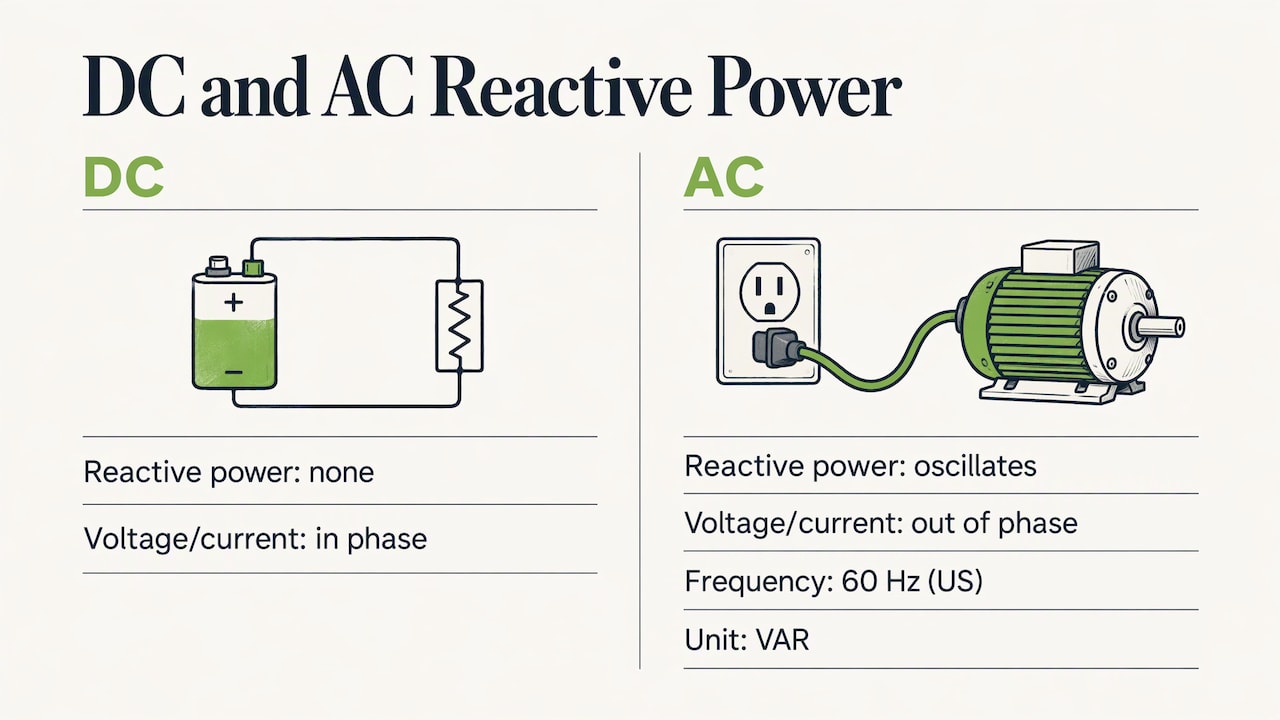
In a direct-current (DC) circuit, voltage and current rise and fall together, and there is no reactive power at all. ROHM’s technical guide notes it does not exist in DC because there is no phase difference between current and voltage.
In an alternating-current (AC) circuit, voltage and current swing back and forth 60 times per second in the US. When the load contains coils or capacitors, current and voltage fall out of step. According to IEEE, reactive power is the component of AC power that oscillates between the source and energy-storage elements such as inductors and capacitors without being converted into useful work. It is measured in volt-amperes reactive, or VAR (kVAR for thousands).
Think of reactive power as a supporting actor. It never takes the lead, but the show cannot run without it. A motor cannot spin until its magnetic field exists, and building that field takes current that is not producing motion.
Real, reactive and apparent power
Three quantities describe AC power, and each has its own unit:
| Type | Symbol | Unit | What it does |
|---|---|---|---|
| Real (active) power | P | watt (W), kW | Runs motors, lights lamps, makes heat |
| Reactive power | Q | VAR, kVAR | Builds magnetic and electric fields, supports voltage |
| Apparent power | S | volt-ampere (VA), kVA | The total the wiring and equipment must carry |
FERC, the US federal energy regulator, describes it the same way: real power accomplishes useful work such as running motors and lighting lamps, while reactive power supports the voltages that must be controlled for system reliability.
The power triangle
The three combine in a right triangle. Real power is the base, reactive power is the height and apparent power is the long side. PVsyst’s documentation gives the formulas, where φ is the angle between voltage and current:
- P = V × I × cos(φ) in kW
- Q = V × I × sin(φ) in kVAR
- Power factor = P / S = cos(φ)
A worked example: a motor draws 80 kW of real power and 60 kVAR of reactive power. Apparent power is the square root of (80² + 60²), which is 100 kVA. The power factor is 80 / 100, or 0.80. The wiring carries current for 100 kVA, but only 80 kW does work.
At the extreme, when voltage and current are shifted by a quarter cycle (90 degrees), SMA explains the result is pure reactive power: the positive and negative parts of the power curve cancel completely, and only active power can do work.
Real power vs. reactive power: the difference
The two are often asked about together, so here is the short version.
- Real (active) power is converted into something you can see or feel: motion, light, heat. It is billed in kilowatt-hours on most residential bills.
- Reactive power is stored in a field for part of each cycle and then handed back. FERC explains that its average value is zero because it pulsates up and down over each cycle.
The Department of Energy’s advisory committee notes that the old name “imaginary power” came from the fact that the out-of-phase energy returns to the source. Today the grid accounts for it in VAR, and “reactive power” is the better-used term.
Where reactive power goes
A common question is where it goes if it does no work. The answer is that it goes nowhere. NJIT’s lab guide explains that energy temporarily stored in electric or magnetic fields is returned to the source, so there is no net energy transfer over a complete cycle.
The catch is the trip. That energy has to travel from the source to the load and back, and the current making the trip heats wires and occupies capacity in transformers and breakers. A Maharashtra utility’s billing FAQ makes the same point: because current is higher than the work requires, the excess dissipates as heat in wires, switches and transformers.
What creates reactive power
Any AC load with a coil or a capacitor shifts the timing between voltage and current.
- Inductive loads consume reactive power. IEEE lists motors and transformer magnetizing branches. The Department of Energy’s power factor guide adds high-intensity discharge lighting. Current lags voltage, which is called a lagging power factor.
- Capacitive loads produce reactive power. Current leads voltage, a leading power factor. SMA notes that multi-core power cables behave like capacitors, while long overhead lines act like inductors.
In a typical home or business, the main sources are air conditioner compressors, pool pumps, refrigerators, well pumps, fans, machine tools and the transformers that feed them. If you want to know which of your appliances pull the most from your bill, our guide to what appliances affect your power bill the most is a good starting point.
Why reactive power affects equipment and costs
On the grid
Utilities need reactive power to hold voltage steady while real power moves over long distances. FERC describes what happens without enough: voltage drops, current rises to compensate, lines consume still more reactive power, and in severe cases lines trip and failures cascade. Consuming reactive power lowers voltage, and supplying it raises voltage.
In your building
Equipment is rated in apparent power (VA), because it must handle the full current. PG&E’s technical note states that distribution losses depend on total apparent power, not just watts. A sustained low power factor, according to the Electrical Engineering Portal, can lead to equipment overheating, lower voltage at the load, and higher resistive and reactive losses.
On the bill
How reactive power reaches a bill depends on the customer class and the utility. Many residential bills charge for kilowatt-hours only. Larger commercial and industrial accounts are different. PG&E’s guide for large facilities says its meters record kW demand, kWh and reactive kVAh for customers with peak demand over 400 kW, and it bills on a power factor averaged over the month. The thresholds are 200 kW at SCE and 300 kW at SDG&E.
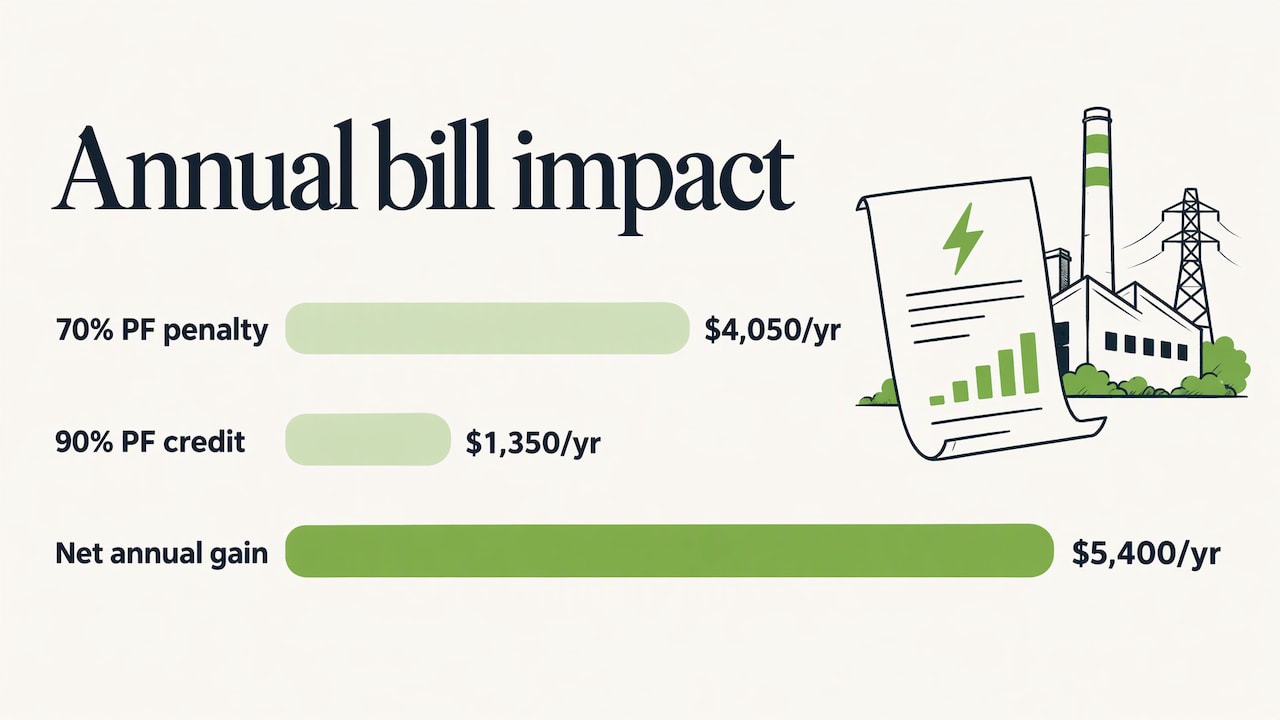
PG&E’s own worked example shows the scale. A 1,000 kW industrial customer at 70% power factor pays a penalty of $4,050 a year on a $450,000 annual bill. Improving to 90% earns a $1,350 credit, a net gain of $5,400 a year.
Penalty rules differ by utility and by tariff. The Electrical Engineering Portal reports that some utilities penalize below 0.96 and others below 0.80. Your rate schedule or your utility account representative will confirm which applies to you. For more on how commercial bills are built, see our guide to business electricity costs.
How reactive power is reduced
The standard remedy is to supply the reactive power close to the load, so it no longer has to travel from the utility and back. The Department of Energy’s guide explains that capacitors store energy and release it opposite to the inductor’s reactive energy, so the two cancel each other locally.
Its worked example: a 100 kW inductive load at 0.70 power factor, with a 67 kVAR capacitor added, drops apparent power from 142 to 105 kVA. That is a 26% reduction in current, and the power factor rises to 0.95.
The same guide lists operating habits that help:
- Avoid running motors idle or lightly loaded.
- Avoid operating equipment above its rated voltage.
- Replace standard motors with energy-efficient ones sized to run near their rated capacity.
- Install capacitors in the AC circuit.
PG&E adds a design point for facilities with rectifiers, variable frequency drives or welders. These loads produce harmonics, so correction equipment must be designed with them in mind, or the capacitor installation can fail. This is the reason correction equipment is worth choosing carefully. Our article on over-correction covers what happens when too much is added.
For a deeper look at the unit itself, see what kVAR is and how it is calculated, and our definition of power factor correction.
Reactive power on properties with solar
Solar inverters interact with reactive power too. SMA’s guide explains that reactive power is unavoidable in AC systems, and inverters are one of the tools used to supply it on the grid side. Our Electric Saver devices are compatible with properties that have solar panels, and we compare the two approaches in solar vs. power factor correction equipment.
Perspective
Reactive power is easy to ignore because you cannot see it. You see the result: motors that run warm, breakers that carry more current than the work seems to need, and bills that are higher than the watts suggest.
We build our devices around that idea. The Electric Saver 1200 is designed to recycle energy and feed it back into the home or business, which is how we approach power factor correction. We offer it in residential and commercial units, with models for single-phase and three-phase systems, and it works with any voltage up to 480v.
The devices are UL and CuL safety listed, verified by UL, GE and NASA, and made in the USA. We stand behind them with a 20-year warranty. Our design combines energy savings with whole-property surge protection, so one installation addresses both the efficiency of your current and the safety of your appliances.
Our aim is to help you save up to 25% on energy costs while extending the life of the equipment you rely on.
Jonica
Choose a correction unit built for your property
If you want to act on what reactive power does to your current, we offer two product lines. The Residential Electric Saver 1200 is made for homes. For commercial properties, our Power Factor Correction Products are priced from $1,499.95 to $1,999.95, one-off. Both are UL and CuL listed, are designed for easy installation and come with a 20-year warranty.

If you are sizing a unit, our page on correct breaker size and the installation guide walk through the setup. Dealers and electricians can find resources in our dealer training hub.
FAQ
What is reactive power in simple terms?
It is the electricity that shuttles between the source and your equipment to build magnetic or electric fields, then returns. It does no work itself, but motors and transformers cannot run without it. It is measured in VAR.
What is the difference between active and reactive power?
Active power, in watts, is turned into motion, light or heat. Reactive power, in VAR, is stored in fields and returned each cycle. Combined, they give apparent power in VA, and the ratio of active to apparent power is the power factor.
What creates reactive power?
Inductive loads such as motors, transformers and high-intensity discharge lighting consume it, according to the Department of Energy. Capacitors and some cables produce it. Most buildings have a mix, with inductive loads dominating.
How do you reduce reactive power?
Supply it locally with correction equipment, and avoid running motors idle or oversized. Large facilities should account for harmonics when sizing equipment. Our Electric Saver line is designed for this, with residential and commercial models.
Does reactive power show up on my bill?
On many residential accounts, billing is by kWh. Large commercial accounts can be billed on power factor or kVA demand, and thresholds differ by utility. Check your rate schedule or ask your utility.
Sources
- Reactive power | IEEE Technology Navigator
- Principles for Efficient and Reliable Reactive Power Supply and Consumption, FERC
- ECE 449 Power Factor Correction, NJIT
- Why reactive power matters, SMA
- What is AC Power?, ROHM TechWeb
- EAC recommendations on the value of VAR, US Department of Energy
- Power Factor, PVsyst documentation
- Understanding Electric Power Characteristics, PG&E
- Economics of Power Factor Correction in Large Facilities, PG&E
- Reducing Power Factor Cost, US Department of Energy
- kVAh Billing FAQs, Maharashtra State Electricity Distribution Co.
- Reactive power compensation, Electrical Engineering Portal