
Peak electricity rates are the higher prices your utility charges for power used when demand on the grid is highest, usually weekday late afternoons and evenings. The exact hours depend on your utility, your rate plan and the season, so the only reliable answer is on your own bill. Because every kilowatt-hour costs more in those hours, the most dependable way to cut the cost is to use less electricity overall, and that is what our Electric Saver 1200 is designed to help with: it is built to save up to 25% on energy costs.
TL;DR
- Peak rates apply when grid demand is highest, typically weekday afternoons and evenings, and the window differs by utility, season and plan.
- Typical windows run from about 2 PM to 6 PM in the Eastern time zone to 5 PM to 9 PM in the Pacific zone, but some utilities peak for eight hours or more.
- Your rate code (for example E-TOU-C) on your bill or online account tells you which schedule you are on.
- Shifting flexible loads helps, but every peak kilowatt-hour still costs more, so reducing total consumption pays off in all hours.
- Businesses may also pay demand charges, which bill their single highest burst of power draw in a month.
Table of Contents
- What peak electricity rates are
- What are peak electricity hours?
- How to find the peak hours on your plan
- What a peak rate costs you: a worked example
- Which uses are worth shifting
- Peak rates for businesses: time-of-use and demand charges
- Is a time-of-use plan right for you?
- Lowering the bill in every hour, not only at peak
- Our perspective
- Put the Electric Saver 1200 to work on your bill
- FAQ
- Sources
What peak electricity rates are
Electricity cannot be stored cheaply on a large scale, so the grid has to produce what customers use at the moment they use it. According to the U.S. Energy Information Administration, wholesale electricity costs are usually higher in the afternoon and early evening, when demand is highest. Prices also vary by locality with power-plant and fuel availability, local fuel costs and regulation.
Utilities pass that pattern on through time-of-use (TOU) rates. Instead of one flat price per kilowatt-hour (kWh, the unit of energy on your bill), a TOU plan splits the day into periods:
- Peak (on-peak): the highest price, when the grid is under the most strain.
- Off-peak: the lowest price, often overnight and sometimes midday.
- Shoulder or mid-peak: a price in between, offered on some plans.
On a flat-rate plan you never see this split, even though the grid’s costs still rise and fall through the day. On a TOU plan, you do.
What are peak electricity hours?
There is no single national schedule. Constellation’s examples show peak windows of 2 PM to 6 PM in the Eastern time zone and 5 PM to 9 PM in the Pacific zone. PG&E’s residential TOU plans apply their higher pricing in windows such as 4 PM to 9 PM or 5 PM to 8 PM, depending on the plan.
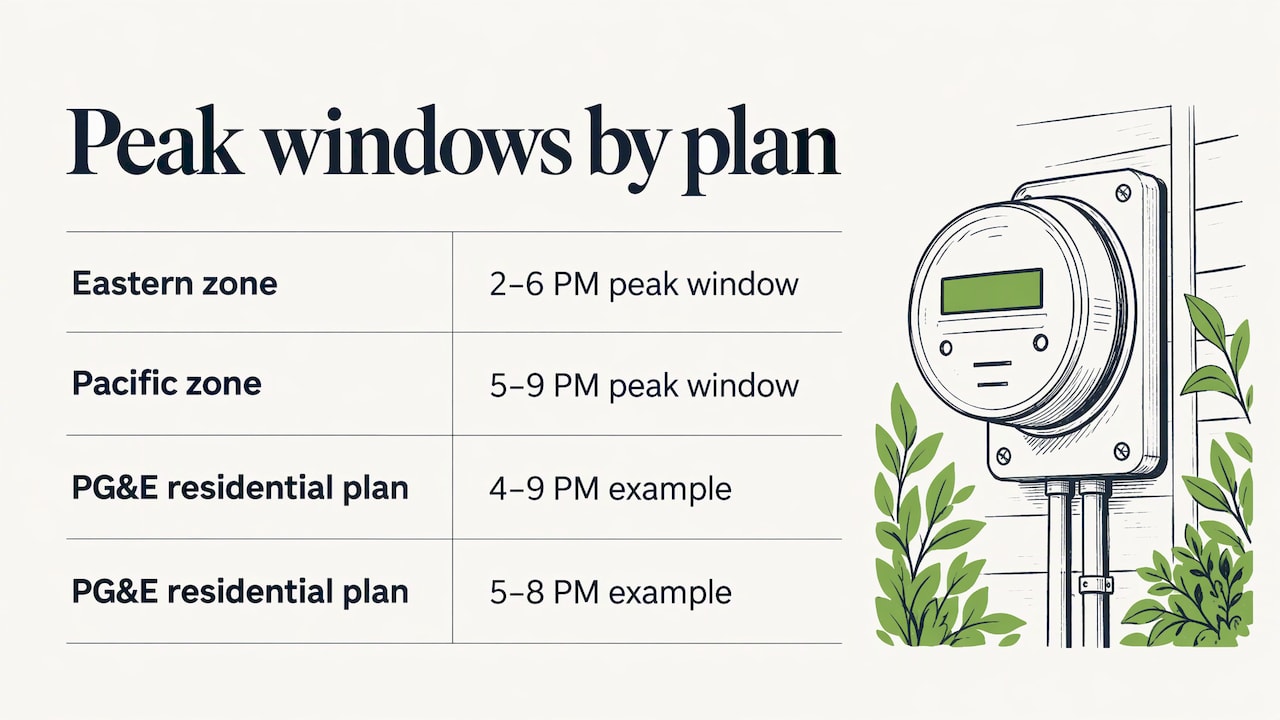
The length of the window varies as much as the start time. A 2026 analysis by NerdyWatts found some utilities peak for four hours or less, while others stretch to eight or more.
Seasons change the window
Many plans use different peaks in summer and winter. Palmetto’s guide notes that summer peaks often land in the late afternoon, while winter peaks often appear in both the morning and the evening. Puget Sound Energy explains that its TOU plans vary peak periods by season and by the specific rate schedule you are enrolled in. Some plans apply peak rates only in summer or only in winter.
Weekdays versus weekends
Peak pricing commonly applies on weekday evenings, and many plans charge off-peak prices on weekends. Check your plan’s fine print, because holidays and weekend rules differ by utility.
Why your neighbor may pay a different rate
Two homes on the same street can be on different plans. One may be on a flat rate, another on a TOU plan with a 4 PM to 9 PM peak, and a third on an EV-only plan with its own meter. A whole-home TOU schedule applies to everything measured by your main meter, while an EV-only plan with a second meter applies only to the charging circuit, as WattWallet explains.
How to find the peak hours on your plan
Guessing from a generic chart is how people end up running the dryer at the worst possible time. Use this routine instead.
- Find your rate code. Open your latest bill or your online utility account. WattWallet advises locating the exact rate code, such as E-TOU-C, because the code identifies the schedule tied to your meter.
- Look up that schedule. Your utility’s rate page lists the peak, off-peak and shoulder hours for each code, by season.
- Note the price gap. Write down the peak and off-peak price per kWh. The size of the gap decides how much shifting is worth.
- Check the baseline rules. Some plans, such as PG&E’s, also use baseline energy allowances that affect the total bill, so the peak price is only part of the picture.
- Confirm your meter. A TOU tariff generally needs a meter that records usage by time period, and Energy Made Easy notes a smart or interval meter may be required.
If you are unsure which plan you are on, EnergySage recommends logging into your utility account or checking a paper bill, and notes that TOU plans need a different calculation than flat-rate plans.
Peak pricing is one reason a bill can climb even when habits have not changed. Our guide on why your electricity bill may be high walks through the other common causes, and our page on understanding watts, kilowatts and your bill explains the units you will see on the statement.
What a peak rate costs you: a worked example
Suppose your plan charges 40 cents per kWh at peak and 15 cents off-peak. These numbers are illustrative, not a quote from any utility.
| Use | Energy | At peak (40¢) | Off-peak (15¢) | Difference |
|---|---|---|---|---|
| Dryer cycle | 3 kWh | $1.20 | $0.45 | $0.75 |
| Evening air conditioning, 4 hours | 12 kWh | $4.80 | $1.80 | $3.00 |
| Electric oven dinner | 2.5 kWh | $1.00 | $0.375 | about $0.63 |
Running the dryer and an air conditioner every weekday at peak instead of off-peak would add up to roughly $75 a month in this example. The same arithmetic works against you if most of your use is unavoidably in the peak window: each kWh saved there is worth the full peak price.
Which uses are worth shifting
The loads that matter are the big, flexible ones. NSW’s energy guidance lists air conditioners, heaters, washing machines, dryers, ovens and dishwashers as heavy users, and notes that timers and other controls can move their running time to cheaper periods. For a typical U.S. home, that translates into:
- Laundry and dishwashing: use the delay-start function to run after the peak window ends.
- Pre-cooling or pre-heating: bring the house to temperature before the peak begins, then let it coast.
- Water heating: if you have a timer or a smart controller, heat water off-peak.
- EV charging: schedule the car for overnight charging.
- Cooking: batch-cook off-peak or use appliances that draw less power at dinner time.
The evidence says this works, up to a point. A 2025 meta-analysis from Resources for the Future of U.S. residential time-based rates estimated an average 16% reduction in peak demand per participant. It also points to control technologies such as programmable thermostats, feedback tools and the timing of the high-priced periods as the drivers of how much customers respond.
There is also a household benefit beyond the bill. Energy Made Easy notes that a TOU plan may save money if you can move use to cheaper periods, for example when you are away on weekday evenings or home during the day or on weekends. Households with solar panels often have midday power available, which can make daytime use cheaper still.
Peak rates for businesses: time-of-use and demand charges
Commercial customers often face two separate peak-related costs.
- Time-of-use energy rates. The same logic as the home: kWh used in the peak window cost more.
- Demand charges. These bill the highest burst of power you draw, in dollars per kilowatt (kW). According to ElectricRates.org, a demand charge is based on the single highest average draw in any 15-minute interval during the billing month. Their example: 42 kW in one interval at a $15 per kW rate is $630 for that month, even if the building idled at far lower levels the rest of the time.
That means a business can pay a great deal for a short spike, such as several motors starting at once. Spreading start-ups across the day, staging equipment and monitoring half-hourly or 15-minute data all help. For a deeper look at how baseload and peak load metrics show where a business can trim its bill, this guide to baseload versus peak load covers the grid metrics in plain terms.
Businesses with motors, compressors, HVAC and other inductive equipment should also look at their power factor, the measure of how efficiently the power drawn is put to work. Our page on what power factor is explains it, and our business electricity costs guide shows where the money goes on a commercial bill.
Is a time-of-use plan right for you?
A short test helps you decide before you switch or stay.
- Can you move 20% or more of your use? If most of your load is movable (EV, laundry, pre-cooling), TOU usually pays. If you are home and cooling all evening with no flexibility, a flat rate may be safer.
- How big is the price gap? A narrow gap makes shifting pointless, and a wide gap rewards it.
- Do you have controls? Smart thermostats, timers and scheduled charging do the shifting for you. Without them, savings depend on remembering.
- Do you generate solar power? RFF notes that solar ownership may influence how customers respond to time-based rates.
The test is your own bill. Compare a few months of your usage by period against the flat and TOU prices your utility publishes, and let the arithmetic decide.
Lowering the bill in every hour, not only at peak
Shifting use only moves consumption from one price to another. Lowering consumption itself reduces the bill in the peak window, the off-peak window and on a flat plan. That is the gap a good plan fills: scheduling for the hours you can control, and efficiency for the hours you cannot.
Start with the basics in our tips to reduce your electric bill and our guide on how to lower power bills and kilowatt usage. They cover lighting, appliances, standby loads and the habits that add the most kilowatt-hours.
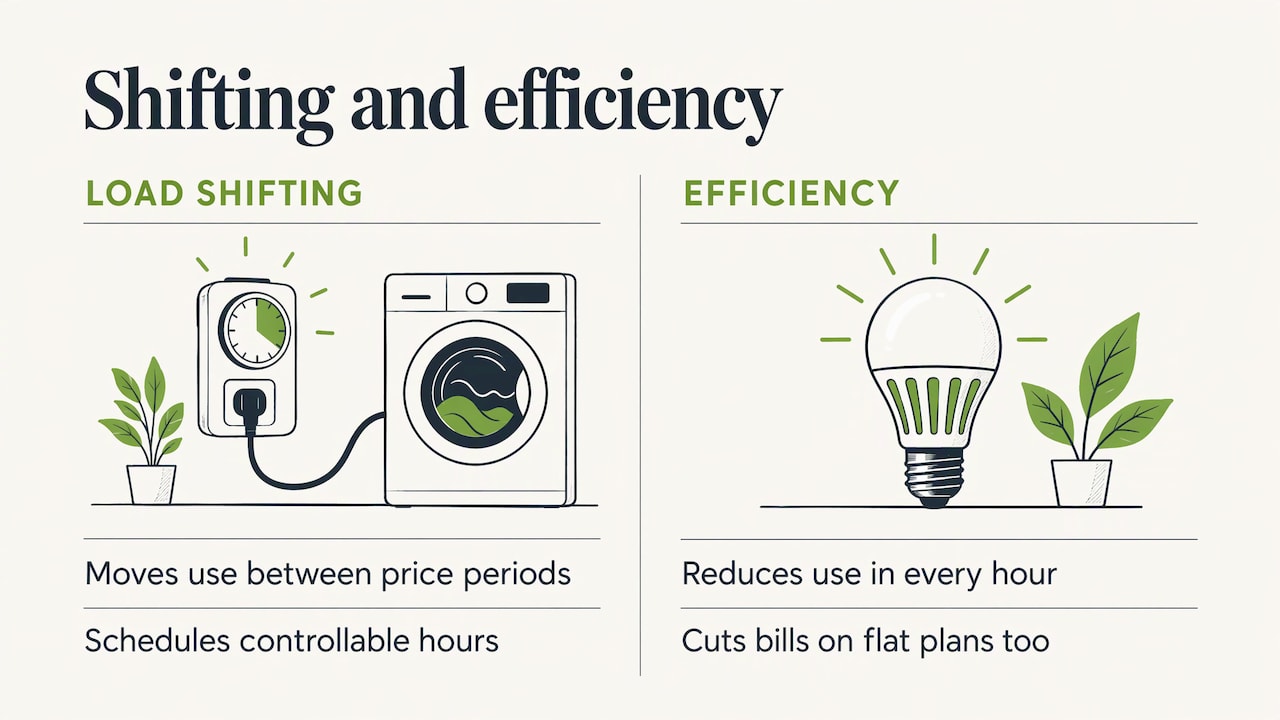
Then consider what happens inside the property itself. Our Electric Saver devices are made for homes and businesses and are designed to reduce electricity bills by optimizing how energy is used, feeding it back into the property. We state that they are UL and CuL safety listed, and that they combine energy savings with whole-property surge protection. They are compatible with voltages up to 480v, including properties with solar panels, and we offer models for single-phase and three-phase systems.
Our perspective
Peak rates make a simple fact more expensive: the grid charges the most when you have the least choice. You cannot always run the dryer at midnight, and a shop cannot stop its compressors at 5 PM.
That is why we start from consumption. A device that works around the clock is designed to lower the energy your property uses in every period, so the savings do not depend on remembering a schedule. The Electric Saver 1200 is built to save up to 25% on energy costs, to add whole-property surge protection and to help extend the life of your appliances.
We make it for single-phase and three-phase systems, residential and commercial, backed by a 20-year warranty and made in the USA. Pair it with sensible scheduling and you give your bill two chances to shrink: fewer kilowatt-hours, and cheaper ones.
Jonica
Put the Electric Saver 1200 to work on your bill
If peak rates are driving your bill up, the Electric Saver 1200 is our answer for the home. It is designed for easy installation, is UL and CuL safety listed, and ships fast with a 20-year warranty. You can see the residential unit on our Residential Electric Saver 1200 page.

For businesses, our Power Factor Correction Products are priced from $1,499.95 to $1,999.95, one-off, and come in models for single-phase and three-phase systems. If you are installing for clients or reselling, our dealer program is open to electricians and dealers who buy in bulk.
FAQ
What are peak electricity hours?
Peak hours are the periods when grid demand, and therefore the price on a time-of-use plan, is highest. In the U.S. they are commonly weekday late afternoons and evenings, with examples ranging from 2 PM to 6 PM Eastern to 5 PM to 9 PM Pacific. Your own window depends on your utility, plan and season.
What are the cheapest hours to use electricity?
Off-peak hours are usually overnight, and on some plans also midday or weekends. Many plans make late night and early morning the cheapest period, but the exact hours are on your rate schedule. Look up your rate code and read the schedule for it.
Do peak rates apply to everyone?
No. Customers on a flat rate pay the same price at any hour. Peak pricing applies to those on a time-of-use plan, and some utilities now make TOU the default for new customers. Your bill or online account shows which plan you have.
How can I avoid paying peak prices?
Move flexible loads such as laundry, dishwashing, water heating and EV charging to off-peak hours, and pre-cool or pre-heat before the peak starts. For the use you cannot move, lowering your total consumption reduces what you pay in every hour, which is the job our Electric Saver devices are designed to do.
Why do peak hours differ between utilities?
Peak hours follow local demand patterns, the mix of power plants and fuels, and regulation, so each utility sets windows to suit its grid. Seasons matter too: summer peaks tend to fall in the late afternoon, while winter peaks can appear in the morning and evening.
Sources
- Prices and factors affecting prices, U.S. Energy Information Administration
- What Are Peak vs. Off-Peak Hours? Constellation
- Time-of-Use Rate Plans, PG&E
- Time-of-Use FAQs, Puget Sound Energy
- When is electricity most expensive? NerdyWatts
- Peak electricity hours: How to find and avoid them, Palmetto
- Off-Peak Electricity Hours by Rate Plan, WattWallet
- How to Determine What Electric Rate You’re On, EnergySage
- What are electricity peak prices? Energy Made Easy
- Tips to use energy when it’s cheap, NSW Government
- Meta-analysis of U.S. residential time-based rates, Resources for the Future
- Demand Charges Explained, ElectricRates.org
- Baseload vs Peak Load: Grid Metrics That Help Businesses Cut Bills