
A commercial electricity bill is not just kilowatt-hours multiplied by a rate. The U.S. average commercial price in 2025 was 13.41¢ per kWh, according to the EIA, but what your business actually pays also depends on demand charges, delivery fees, riders and, on many rate plans, your power factor. The fastest way to lower the bill is to read it line by line, find the charges driven by your peak load and your equipment, and then correct those causes. For many businesses that means smoothing peaks and correcting power factor, which is what our commercial power factor correction units are built for.
TL;DR
- The 2025 U.S. average commercial price was 13.41¢/kWh, against 17.30¢/kWh for residential, but your own bill can differ widely because of demand charges and rate plan.
- Demand charges, based on your highest power draw in a short interval, can make up 30% to 70% of monthly bills for many commercial customers.
- Low power factor can trigger a tariff penalty, so check your rate schedule before assuming usage is the only lever.
- Start with a line-by-line read of the bill, then act on peaks, equipment and rate plan, in that order.
- Our Power Factor Correction Products for commercial properties are listed at $1,499.95 to $1,999.95 as a one-off price.
Table of Contents
- What the average commercial price tells you
- The line items on a commercial bill
- Why demand charges decide so many bills
- Rate plans differ by size, utility and location
- Power factor: the charge many businesses overlook
- A step-by-step way to lower a commercial bill
- A worked example
- Where commercial and residential differ
- Our perspective
- Power factor correction for your property
- FAQ
- Sources
What the average commercial price tells you
The U.S. Energy Information Administration reports 2025 average retail prices of 17.30¢/kWh for residential customers, 13.41¢/kWh for commercial and 8.62¢/kWh for industrial customers. The EIA explains the gap by distribution cost: serving homes and commercial buildings costs more per unit than serving industrial users, who take power at higher voltages and use far more of it.
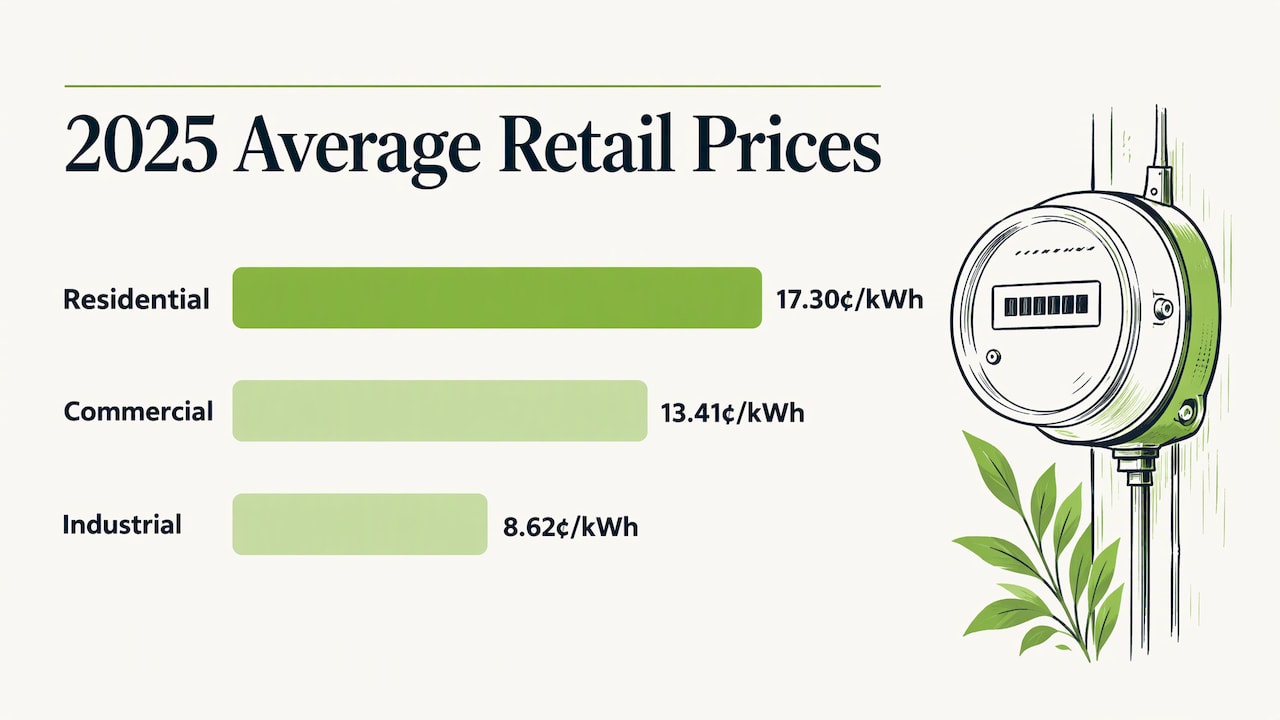
So yes, commercial power is cheaper per kWh than residential power on average. That average hides the part that matters to you. The per-kWh figure usually blends energy charges with demand and delivery charges, and a business with spiky usage can end up far above it while a steady, around-the-clock load ends up below it.
A quick illustration. A shop using 10,000 kWh in a month at the 2025 national average of 13.41¢ would pay about $1,341 for energy alone (10,000 × $0.1341). The real bill adds customer charges, delivery, taxes and, most likely, a demand charge. Your own statement, not a national average, is the benchmark.
The line items on a commercial bill
Bill layouts differ by utility, but the building blocks are similar. Southern California Edison’s business bill guide lists customer, energy, demand, delivery, generation, program, regulatory and tax items, plus credits for qualifying programs. Which ones appear depends on your rate plan and jurisdiction.
| Line item | What it covers | What moves it |
|---|---|---|
| Customer or service charge | A fixed monthly fee for billing, metering, customer service and distribution facilities, as SRP describes it | Nothing you do day to day |
| Energy charge | Cents per kWh consumed, which can vary with time of use | Total usage and when you use it |
| Demand charge | A price per kW of your highest draw in a billing interval | Your peak, not your total usage |
| Delivery and generation | The cost of moving power over the utility’s wires and of producing it | Rate class and utility |
| Riders, programs, taxes | Fuel, infrastructure and regulatory pass-throughs | Regulation and utility filings |
The U.S. Department of Energy’s guide for Ohio businesses calls understanding the utility bill an important first step toward lowering energy costs. That is the right order of work: read first, then act.
Why demand charges decide so many bills
Residential customers almost never see a demand charge. Commercial customers usually do. Kilowatt-hours (kWh) measure how much energy you used over time. Kilowatts (kW) measure how hard you drew on the grid at one moment. The utility has to build and maintain capacity for your highest moment, so it bills for it.
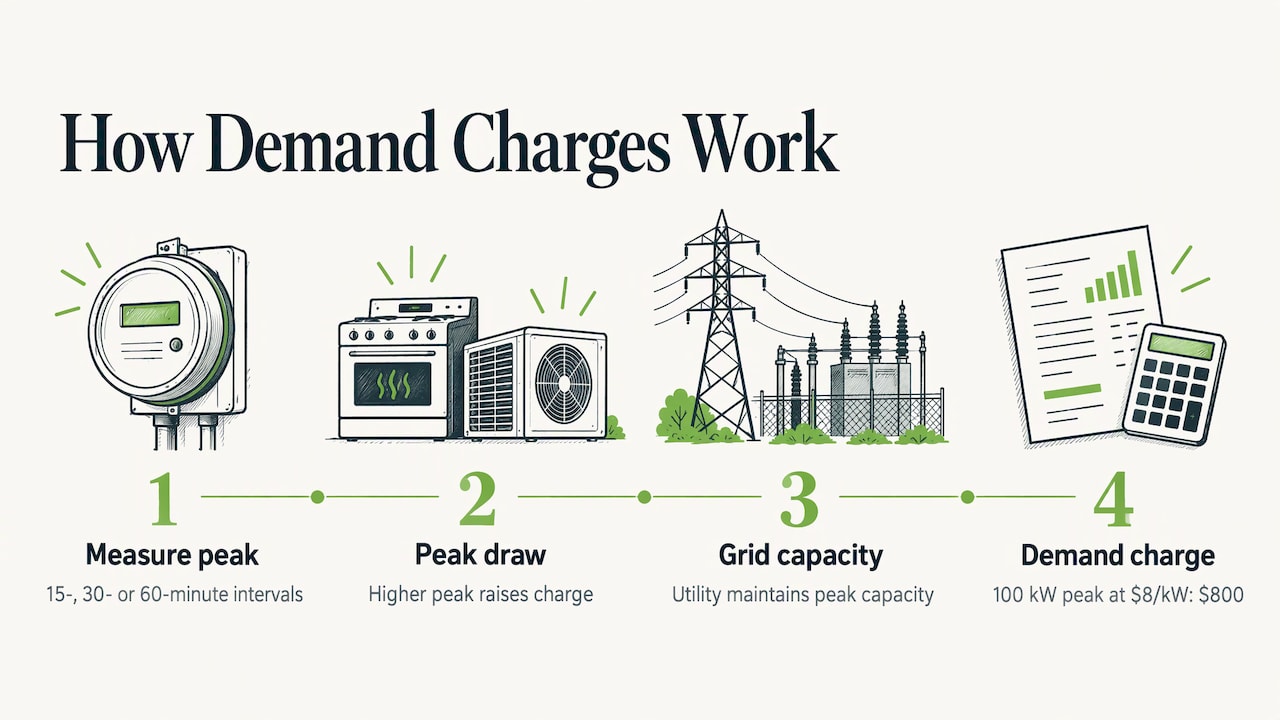
The Massachusetts Office of Technical Assistance explains that demand may be measured over 15-, 30- or 60-minute intervals, depending on the rate, and that a higher peak in any interval raises the charge.
The City of Roseville gives a clear example: a business with a 100 kW peak at $8 per kW pays $800 in demand charges, even if its monthly kWh use is far lower than a steady-load business. One half-hour when the compressors, ovens and HVAC all start together can set the demand charge for the entire month.
If demand charges are a large share of your bill, our guide to peak electricity demand and the explainer on peak electricity rates cover how the timing works.
Rate plans differ by size, utility and location
Two businesses on the same street can sit on different schedules. PSEG Long Island’s tariff effective January 1, 2026 differentiates commercial rates by customer size and demand and requires time-of-use rates for large-use customers. Southern California Edison assigns different plans to small, medium and large business bands, and its TOU-8 plan is mandatory above 500 kW.
Two practical consequences follow:
- Check the rate schedule printed on your bill, and confirm with the utility that it is the right one for your load. The University of Nebraska–Lincoln Extension recommends exactly this check.
- Time-of-use pricing makes the hour of consumption matter as much as the quantity.
Power factor: the charge many businesses overlook
Power factor is the ratio of the power doing useful work (real power, in kW) to the total power the utility has to supply (apparent power, in kVA). Motors, compressors, pumps, refrigeration and HVAC equipment create reactive power. Think of it as a supporting actor: it does not deliver the headline output, but the equipment cannot perform without it, and the utility still has to carry it through its wires.
When power factor is low, you draw more current for the same useful work. The Massachusetts guidance on demand charges recommends checking whether low power factor leads to a tariff penalty. Some tariffs bill on kVA or add a surcharge below a threshold. If yours does, the penalty shows up as a line or as a higher demand figure.
How to find out:
- Look on the bill for a power factor figure, a kVAR or kVA reading, or a power factor adjustment.
- Read your utility’s tariff schedule for a stated minimum power factor.
- Ask the utility which interval and measure it uses for demand.
If your bill does not charge for power factor, correction will not change that bill. If it does, correction is aimed at the cause. Our page on what power factor is walks through the basics, and the one on over-correction explains why sizing matters.
A step-by-step way to lower a commercial bill
1. Pull twelve months of bills
Seasonal swings in demand and usage show up only across a full year. Mark the months with the highest demand charge and the highest kWh.
2. Separate usage from demand
Divide the bill into energy charges (kWh) and demand charges (kW). If demand is a large share, usage cuts alone will disappoint you.
3. Find the peak
Use interval data from your utility if available. The Massachusetts guidance suggests reviewing interval load profiles, staggering equipment startup and considering soft starters for large motors, which limit the surge when a motor starts.
4. Check the rate schedule
The Department of Energy guide lists considering a different rate schedule alongside revising operating schedules, replacing inefficient equipment and investigating efficiency and demand-response programs.
5. Check power factor and correct it where it is penalized
If your tariff penalizes low power factor, install correction equipment sized to your load. Our commercial units come in models for single-phase and three-phase systems and work with voltages up to 480V. A power factor correction unit is designed to cut the reactive portion of the load the utility sees. Installation details are on our installation page.
6. Trim usage and shift flexible loads
The Nebraska guide recommends reducing unnecessary usage, moving to lower-wattage equipment, staggering high-load startups and shifting flexible processes to off-peak periods where the tariff rewards it.
7. Look at the building itself
Heating and cooling are often the largest loads, so the envelope matters. Roof condition and insulation influence cooling demand, and the factors behind commercial roof installation costs are worth understanding before a replacement is planned. Many utilities also offer assessments: Idaho Power’s commercial audit, for example, can identify HVAC, lighting and building-envelope opportunities for qualifying customers.
A worked example
Imagine a small manufacturer with a 100 kW peak at $8 per kW, the same rate Roseville uses in its example. The demand charge is $800 a month, or $9,600 a year, before a single kWh is billed. If better startup sequencing and equipment changes lower the peak to 80 kW, the charge falls to $640 a month. That is $160 a month, or $1,920 a year, from the demand line alone. The numbers are illustrative, so substitute your own rate and peak.
Now add a utility that surcharges for low power factor. Correcting it removes that surcharge and can lower the apparent load on your service. The combined effect varies by tariff, which is why the first job is always to read your own bill.
Where commercial and residential differ
Homes draw low-voltage power in unpredictable spikes and use little per account, so fixed metering, billing and infrastructure costs spread over few kWh. Commercial accounts use more volume, often at higher voltages, and steady loads are cheaper to serve. Commercial bills also split into energy, demand and rider charges and more often use time-of-use rates. If you run a home-based business or a mixed property, check which rate class your meter sits on.
For related reading, see our pages on business electricity costs and commercial energy efficiency.
Our perspective
We look at a commercial bill the way an electrician looks at a panel: what is the load doing, and what is the utility charging for it?
Most owners focus on kWh because it is the number they can picture. The money, though, often sits in the peak and in the power factor, because those are the charges tied to how your equipment behaves rather than how long it runs. That is why we build our devices around correcting the reactive part of the load and protecting the property from surges at the same time.
Our units are UL and CuL listed, made in the USA, designed for easy installation and compatible with voltages up to 480V, including properties with solar panels. Models are available for single-phase and three-phase systems, and we back them with a 20-year warranty. We would rather an owner read the bill first and size the solution to it, because that is how the savings we design for show up on the statement.
Jonica
Power factor correction for your property
Our Power Factor Correction Products for commercial properties are listed at $1,499.95 to $1,999.95, a one-off price. They are designed to optimize unused energy, add whole-property surge protection and ease the load that low power factor puts on your system. Dealers and electricians can buy in bulk through our dealer program.

See the units and choose the model for your system on our commercial page. Homeowners can find the Residential Electric Saver 1200 there as well, and our team ships orders quickly.
FAQ
Is commercial electricity cheaper than residential electricity?
Per kWh, usually yes. The EIA’s 2025 U.S. averages were 13.41¢ for commercial and 17.30¢ for residential. Commercial bills also carry demand charges that homes rarely face, so your total cost depends on your peak as well as your usage.
Why is my commercial electric bill so high?
The usual causes are a high peak demand charge, usage during expensive time-of-use hours, an unsuitable rate schedule or a low power factor. Compare twelve months of statements to spot which line grew. Our page on finding the cause of a high electricity bill gives a checklist.
What share of a commercial bill is demand charges?
NYSERDA reports that demand charges can account for 30% to 70% of monthly bills for many commercial customers. It is a reported range, not a rule, so look at the demand line on your own statement.
How is a commercial bill calculated?
It combines a fixed customer charge, an energy charge per kWh, a demand charge per kW of peak, delivery and generation charges, and riders and taxes. Your rate plan decides which apply. Multiplying kWh by your energy rate gives only the energy portion.
Sources
- Prices and factors affecting prices, U.S. Energy Information Administration
- How Energy Storage Can Reduce Electricity Costs for Commercial Energy Users, NYSERDA
- Components of your Energy Bill, Southern California Edison
- Understanding Your Utility Bill: A Guide for Businesses, U.S. Department of Energy
- How to read your bill, SRP
- Understanding Your Electric Bill: Saving Money on Demand Charges and Power Factor, Mass.gov
- Understand your energy bill, City of Roseville
- Commercial tariff, PSEG Long Island
- Rates by Business Size, Southern California Edison
- Understanding Electricity Bills, University of Nebraska–Lincoln Extension
- Energy Assessments, Idaho Power
- Key Factors in Commercial Roof Installation Costs