A plug-in surge protector typically needs replacing every three to five years. Its real life is set by how much surge energy it has absorbed, not by the calendar. A strip can look healthy and still protect nothing. A whole-property protector, wired in at the panel, is built to cover every circuit and gives you far less to track. Our complete home surge protection system is made for that purpose.
TL;DR
- Plug-in surge protectors are commonly replaced every 3 to 5 years, and sooner in storm-prone areas.
- Lifespan is measured in joules absorbed. Every surge uses up some of the protector’s capacity.
- A green “protected” light does not prove the protector still works.
- Replace a unit right away after a nearby lightning strike, a major outage or any sign of scorching, melting or overheating.
- One protector at the electrical panel covers the whole property, so there are no strips to date and track.
Table of Contents
- How long does a surge protector last?
- Do surge protectors expire?
- What actually wears a surge protector out
- Signs it is time to replace your surge protector
- Will it still power your devices after protection ends?
- Plug-in strips, UPS units and whole-house protectors compared
- A simple replacement routine
- Our perspective
- Protect the whole property with one device
- FAQ
- Sources
How long does a surge protector last?
The figure you will see most is three to five years. Engadget reports that some manufacturers suggest replacing a unit in that window. It also stresses that this is a suggestion, not a guarantee. If you cannot tell how old a strip is, or whether it still protects, replacing it is the smartest option.
Some sources are more cautious. PEMCO says most experts give a good protector two to five years. It adds that utilities experts suggest two years as the safest replacement interval and five as the maximum.
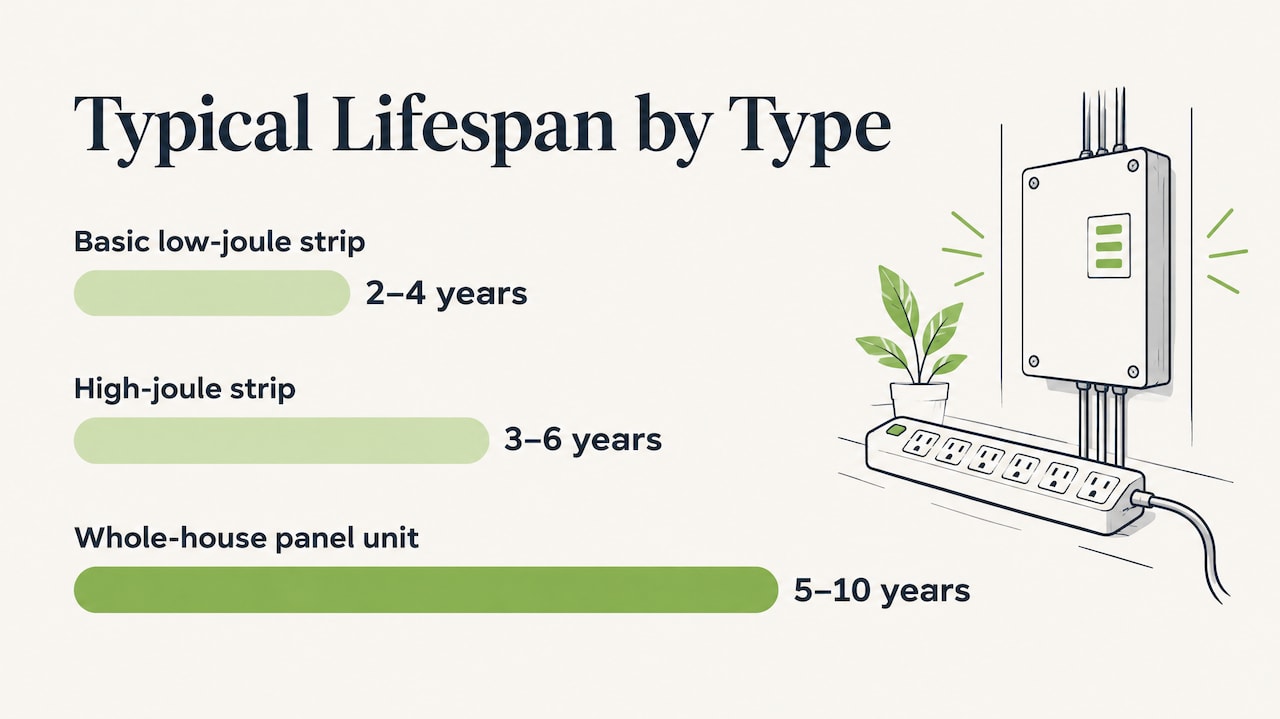
Typical ranges by type, from a 2026 guide:
| Type | Typical lifespan |
|---|---|
| Basic low-joule power strip | 2 to 4 years |
| High-joule power strip | 3 to 6 years |
| Whole-house panel unit | 5 to 10 years |
| Any unit in a lightning-prone area | Roughly half the usual range |
These ranges come from OnOtto’s lifespan table. Treat them as guides, not guarantees.
Do surge protectors expire?
Not on a date. UL Solutions states that power strips and surge protectors don’t expire or need replacement after a specific amount of time. It also says you should inspect the cord and strip and replace them if damaged.
The three-to-five-year rule exists because wear is hard to see. HowToGeek explains that lifespan is measured in joules. Once a protector has carried its rated energy to ground, it should be replaced. Its example: a 2100-joule protector could be used up by one 1100-joule hit plus five 200-joule hits. Since you cannot see how much energy a unit has diverted, most insurers recommend replacement every three to five years, and more often in severe-storm areas.
What actually wears a surge protector out
Inside most protectors are parts called metal-oxide varistors (MOVs). They absorb the extra voltage of a surge and send it to ground. Popular Mechanics explains that MOVs wear away bit by bit with every surge they absorb. A worn unit keeps powering your electronics while offering no protection.
Four things shape how fast that happens:
- How often surges hit. Storms, grid switching and big appliances cycling on and off all contribute.
- How large the surges are. A typical surge consumes about 100 joules, while larger events can use up 1,000 joules or more at once.
- The joule rating. A higher rating means more energy to spend before the unit is exhausted.
- Build quality and electrical load. These also affect how long a unit holds up.
The NIST guide to surges adds that many electronic components age and have limited life. It also notes that specialists believe most catastrophic protector failures come from excessively high line voltage caused by a power-system fault, rather than from very large surges alone. Read it at NIST Special Publication 960-6.
To see what ratings mean in practice, read our guide on how many joules of surge protection you need.
Signs it is time to replace your surge protector
Replace immediately after a major event
A nearby lightning strike, a transformer malfunction, or several outages in quick succession can drain a protector at once. Wirecutter advises replacing plug-in units right away after a large power event. PEMCO notes that a worn-out unit can overheat, spark or ignite nearby materials. No standard surge protection device can handle a direct lightning strike, so a unit that took a close hit should not stay in service.
Replace when you see physical damage
Discoloring, overheating, melting, burn marks or a scorched smell mean the unit is done. Idaho Power advises replacing a suppressor that shows these signs, or one with no lights to show it is working. MakeUseOf gives the same advice for burn marks and smells.
Do not trust the green light alone
A “protected” light shows only that a thermal fuse is intact. It does not show that the MOVs still have capacity. MakeUseOf reports that a unit that absorbed hundreds of small spikes over six years can show green while offering almost no protection. The home inspectors’ association NACHI also warns that lights and alarms are no guarantee of function. It adds that failed MOVs that are not disconnected have been known to start fires.
Check the date and the standard
Write the purchase date on the unit with a marker. Look for the UL 1449 mark. Idaho Power notes the standard was updated in 2021, so units built to older editions could be less effective.
Check the outlet
NACHI notes that a surge protector will not work if the outlet has no ground wire. A new strip in an ungrounded outlet gives you nothing, however young it is.
Will it still power your devices after protection ends?
Often yes, and that is the trap. NIST explains that some protectors keep supplying power after the protective function fails. Others cut off power when it fails. Check your unit’s packaging or manual to learn which kind you own. A unit that shuts off tells you it has failed, while one that keeps running leaves you exposed without warning.
Plug-in strips, UPS units and whole-house protectors compared
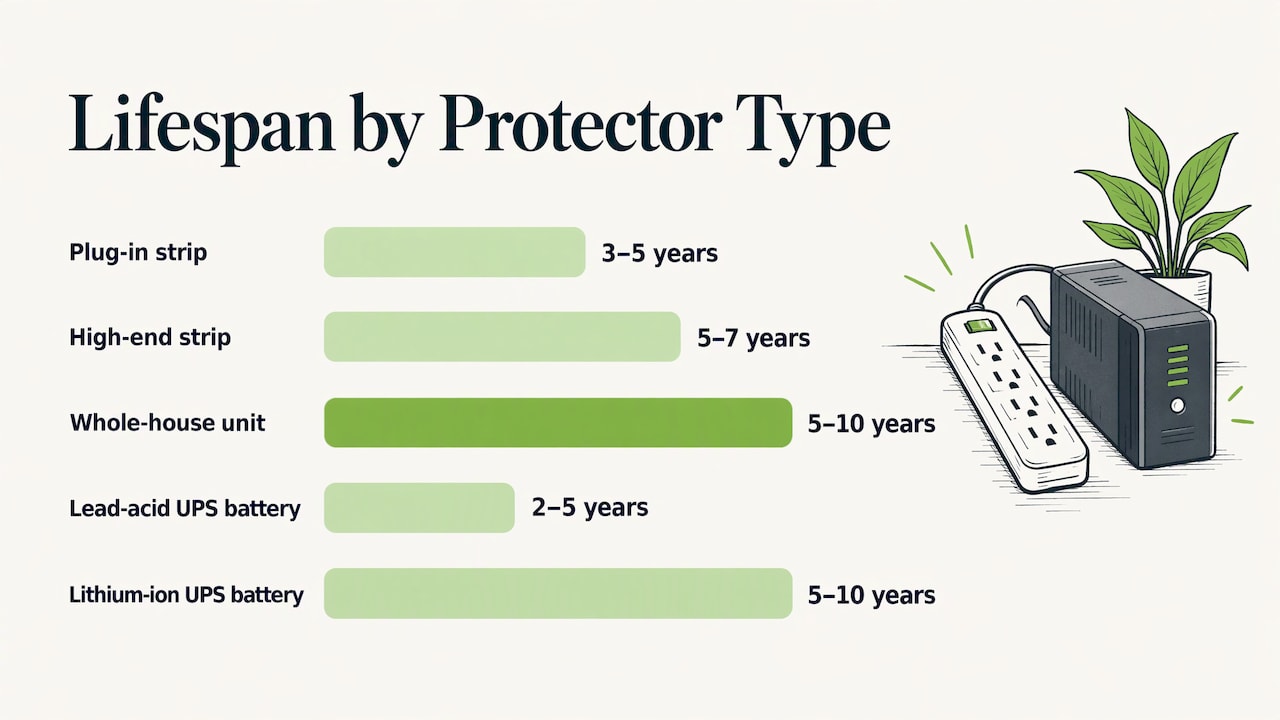
Plug-in strips are consumables. One 2026 guide puts quality strips at 3 to 5 years, with high-end models reaching 5 to 7. The same guide gives whole-house units 5 to 10 years. A battery backup (UPS) has two clocks: the surge circuitry, and the battery, which is typically 2 to 5 years for sealed lead-acid and 5 to 10 for lithium-ion.
For a home, the practical difference is the number of devices to track. A house with ten strips has ten purchase dates, ten indicators and ten sets of unknown joules used. A protector at the panel is one device that guards every circuit, including hardwired appliances that never touch a strip, such as the air conditioner, the water heater and the refrigerator.
If you want to understand how this kind of protection works, start with how a surge protector works. Our guide to what causes power surges and the best complete home surge protector goes further.
A simple replacement routine
- List every surge protector in the house, including those behind the TV, the desk and the washer.
- Mark each with its purchase date. If you cannot find a date, treat the unit as old.
- Inspect the cord, casing and plug for heat marks or damage.
- Confirm the outlet is grounded. If you are unsure, have a licensed electrician test it.
- Replace plug-in units at three to five years, sooner after storms or outages.
- After any close lightning strike or major outage, replace the units that were plugged in.
- Choose a rating for what you protect. MakeUseOf suggests 1,000 joules for basic setups, 2,000 or more for a home office and 4,000 or more for expensive gear.
An electrician is the right person for the grounding check and for any wiring at the panel. That is also where a whole-property protector goes.
Our perspective
Surge protection is only as good as your ability to know it still works. With plug-in strips, that knowledge fades after a few years, because the wear is invisible and the light can mislead.
That is why we think about protection at the property level. Our devices are UL and CuL listed and are designed for easy installation. They protect the whole property, and they are compatible with any household or business voltage up to 480v, including properties with solar panels. Models are made for single-phase and three-phase systems. They are made in the USA and come with a 20-year warranty.
Surge protection is built into the same device that is designed to cut your electricity costs, so one purchase serves two goals.
Jonica
Protect the whole property with one device
If you would rather not track a drawer of aging strips, the Electric Saver 1200 gives you whole-property surge protection and is designed to reduce electricity bills. The residential unit is available on our Residential Electric Saver 1200 page. Businesses can look at our power factor correction products, listed at $1,499.95 to $1,999.95 one-off.

It is compatible with solar properties, ships fast and carries a 20-year warranty. Install guidance is on our panel installation tips page.
FAQ
How long do surge protectors last?
Most plug-in protectors are commonly replaced every three to five years. Storm-prone areas and frequent outages shorten that. The true limit is the energy absorbed, so one large surge can end a unit’s life early.
Do surge protectors have an expiration date?
There is no printed expiration date. UL Solutions says they don’t expire after a set time, but they should be replaced if damaged. Wear from surges is hidden, which is why the three-to-five-year replacement guideline exists.
When should I replace a surge protector?
Replace it at three to five years, right after a nearby lightning strike or major outage, and whenever you see discoloration, melting, overheating or a burning smell. Also replace it if you cannot tell its age or whether it still protects.
Can a surge protector be dead while the light is on?
Yes. The green light only shows a thermal fuse is intact. The varistors that absorb surges can be worn down while the light still glows.
Sources
- Engadget: Why It’s Important To Regularly Replace Your Surge Protector
- PEMCO: Is your surge protector several years old?
- OnOtto: How Long Does a Surge Protector Last?
- UL Solutions: Guide to Power Strips and Surge Protectors
- HowToGeek: Your old surge protectors aren’t protecting anything
- Popular Mechanics: How Often You Need to Replace Your Surge Protectors
- NYT Wirecutter: How to Use Surge Protectors
- NIST Special Publication 960-6
- MakeUseOf: How to check a surge protector
- NACHI: Surge Protectors
- Idaho Power: How to Choose the Right Surge Suppressor
- Cook Your Tech: How Long Do Surge Protectors Last?