
A high electricity bill almost always comes down to one of two things: you used more kilowatt-hours (kWh), or you paid more for each one. Compare both numbers with the same month last year and you will know which it is within five minutes. Once you know, you can fix the usage, the plan, or the way your property draws power. Our Electric Saver 1200 is built for that last part: it is designed to save up to 25% on energy costs while also giving your whole property surge protection.
This guide walks through the check, the usual culprits, the appliances to look at first, and what to do next for a home or a business.
TL;DR
- Divide your total charges by your kWh, then compare kWh and cost per kWh with the same month last year. That tells you whether usage or price moved.
- Heating and cooling are the biggest users in most US homes, followed by water heating and appliances.
- Longer billing cycles, estimated meter readings, expired contracts and new devices can all make one bill jump without any change in habits.
- Lasting savings come from cutting waste (insulation, efficient appliances, off-peak habits) and from optimizing how your property uses the power it draws.
- The Electric Saver 1200 is designed to cut energy costs by up to 25% and protect appliances from surges, for homes and businesses.
Table of Contents
- Start with the two-number check
- Rule out billing causes first
- What uses the most electricity?
- Common reasons a bill suddenly rises
- A 30-minute plan to find your cause
- Cheap fixes that reduce usage
- Why usage cuts alone often stall
- The Perspective from our side
- Choosing the right Electric Saver
- Put the Electric Saver 1200 to work on your bill
- FAQ
- Sources
Start with the two-number check
Before you unplug anything, read your bill. APG&E suggests comparing two numbers against the same month last year: total kWh used, and price per kWh, which you get by dividing total charges by kWh.
Here is how to read the result:
- kWh is up, price per kWh is flat: you are using more. Look at weather, new devices and habits.
- kWh is flat, price per kWh is up: your rate changed. Look at your plan, contract and delivery charges.
- Both are flat but the total is up: check the number of days in the billing period and whether a meter reading was estimated.
A worked example: a bill of $210 for 1,400 kWh works out to $0.15 per kWh. If last July the same house paid $150 for 1,000 kWh, the rate is identical and the whole difference is 400 extra kWh. Consumer Reports uses the same arithmetic to describe the supply charge, which often makes up the biggest part of a bill: kWh used multiplied by the supply rate, so 1,000 kWh at $0.15 is $150.
This is also the honest answer to “is $150 a lot?” There is no universal line. Bills vary with the state, the season, the size of the home and the rate. Your own history, kWh and rate, is the only fair benchmark.
Rule out billing causes first
Some high bills have nothing to do with how much power you used. Check these before you start changing habits.
Longer cycles and estimated readings
Direct Energy advises comparing five items side by side when a bill jumps: kWh, days in the billing cycle, the rate, delivery charges and whether the previous reading was estimated. When an estimate is corrected by an actual reading, the next bill can look unusually high.
Con Edison lists the same factors and adds a practical accuracy check: photograph your meter, review the 13-month usage chart on your bill, and read the meter yourself. Your own reading will come out slightly higher than the bill, because the bill was cut earlier. If the numbers still look wrong, contact your utility.
Rate changes and expired contracts
The Public Utility Commission of Texas lists the usual reasons a total changes: usage, weather, market factors such as natural gas prices, utility rate changes, a contract expiring and moving you to a month-to-month variable rate, or switching plans. In competitive markets, check your contract end date. In regulated areas, check your utility’s rate announcements.
Fuel costs matter too. Consumer Reports notes that natural gas, the most common fuel for US power generation, can double or triple in price within a year, and utilities pass nearly all of that cost through. Grid upgrades and storm damage add to rates as well.
Business bills
Commercial bills add demand charges and, often, power factor penalties. If you run motors, compressors, pumps or HVAC, reactive power can raise the current your meter and utility see without doing useful work. We explain that in plain terms in our guide to what power factor is.
What uses the most electricity?
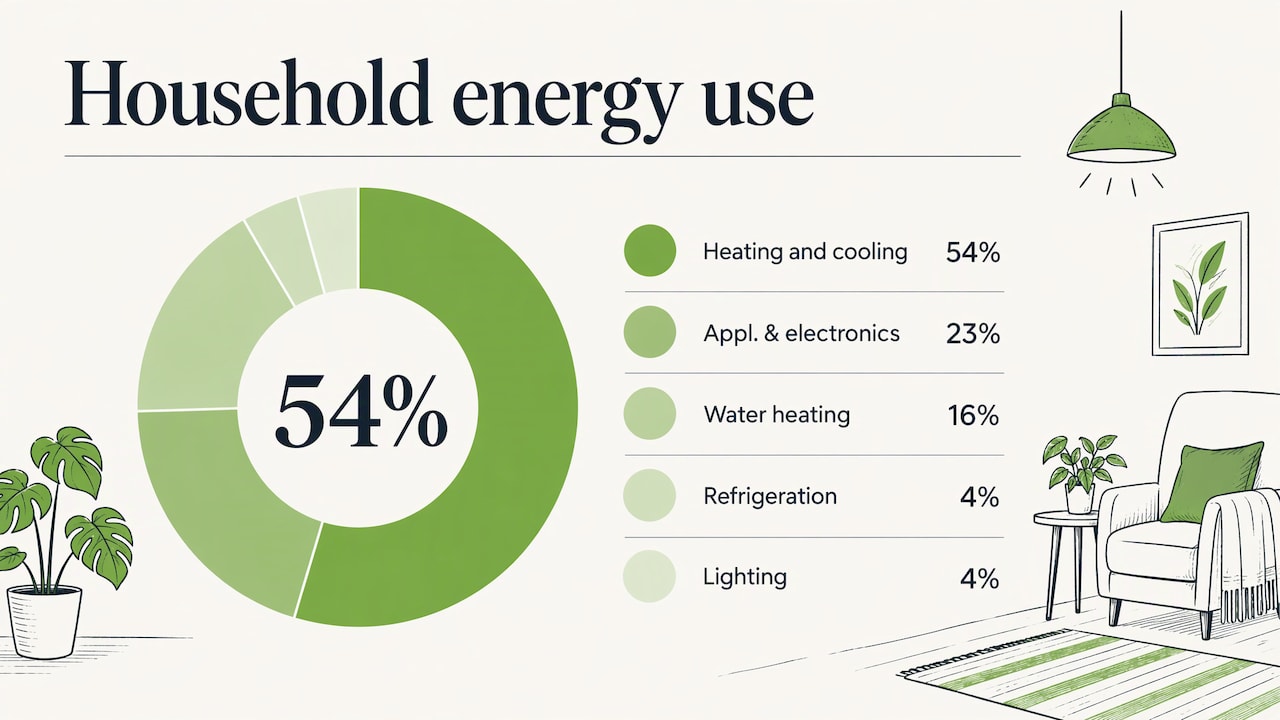
If billing is clean and usage is up, find the big loads. Direct Energy’s breakdown of a typical US single-family home looks like this:
| Category | Share of home energy use |
|---|---|
| Heating and cooling | 54% |
| Appliances and electronics | 23% |
| Water heating | 16% |
| Refrigeration | 4% |
| Lighting | 4% |
Seattle’s city utility gives a similar picture, with heating and cooling at 40 to 50% and water heaters at 10 to 15%, and notes that the shares shift with appliance efficiency, habits and household size. The US Department of Energy adds that heating can account for almost half of an average family’s winter energy bill.
So yes, heat affects the bill, and so does cold. Summer air conditioning and winter heating are the two biggest swings. A central air conditioner alone uses more than 2,000 kWh per year on average, according to the same Direct Energy breakdown.
For a deeper look at individual appliances, see our page on which appliances affect your power bill the most.
Common reasons a bill suddenly rises
If last month was normal and this one is not, run down this list:
- Weather. A heat wave or cold snap makes HVAC run far longer.
- New load. An EV charger, pool pump, space heater, dehumidifier or a second refrigerator adds kWh every day.
- Standby power. Devices that stay plugged in add a small constant draw. These are the so-called power vampires.
- Aging equipment. Old air conditioners, water heaters and refrigerators work harder for the same result. Dirty filters and low refrigerant do the same.
- Poor insulation and air leaks. Conditioned air escapes, so the system runs more.
- More time at home. Remote work, school holidays and guests all raise daytime use.
- A changed heating system. Switching to electric heat, or running a heat pump through a deep freeze, changes your pattern. This overview of heat pump electricity usage in cold climates shows what to expect.
APG&E’s list of eight common causes covers the same ground and adds a plan that does not suit your usage pattern. If your rate plan charges more at peak hours, running the dryer, dishwasher and EV charger in the evening can cost noticeably more. On time-of-use plans, PG&E says rates are highest between 4 and 9 p.m. on its plans, so check your own utility’s peak window.
A 30-minute plan to find your cause
- Pull 13 months of usage. Most utilities show it on the bill or the online account.
- Calculate cost per kWh for the high month and the same month last year.
- Count billing days. A 34-day cycle will cost more than a 28-day one at the same daily use.
- Check estimated reads. Look for an “E” or “estimated” note and compare against your own meter reading.
- List what changed. New devices, guests, a broken thermostat schedule, a failing appliance.
- Walk the big loads. Thermostat setting, HVAC filter, water heater temperature, pool pump timer.
- Call the utility if the numbers do not add up. Ask for a bill review or a meter test.
If you are struggling to pay while you sort this out, contact your utility. Many offer payment plans, and some programs offer discounts or assistance depending on where you live and your income.
Cheap fixes that reduce usage
These steps cost little and work on any property:
- Thermostat. Heating and cooling are the largest slice, so start here. A Citizens Utility Board outreach director told Consumer Reports that holding a thermostat at 72 degrees year-round is not ideal.
- Water heater. Direct Energy suggests setting it to 120°F.
- Filters and maintenance. Keep the AC serviced and filters clean.
- Attic insulation and drafts. Seal gaps around doors, windows and ducts.
- Ceiling fans to make a room feel cooler at a higher thermostat setting.
- Unplug unused electronics or put them on a switched strip.
- Shift heavy use off-peak if your plan has time-of-use pricing.
We have more detail in our guides to conserving electricity at home and lowering your electric bill.
For bigger projects, some upgrades pay back over years. Roof and building-envelope changes are one example: a green roof and its advantages include better insulation and lower heating and cooling demand for the building underneath.
Why usage cuts alone often stall
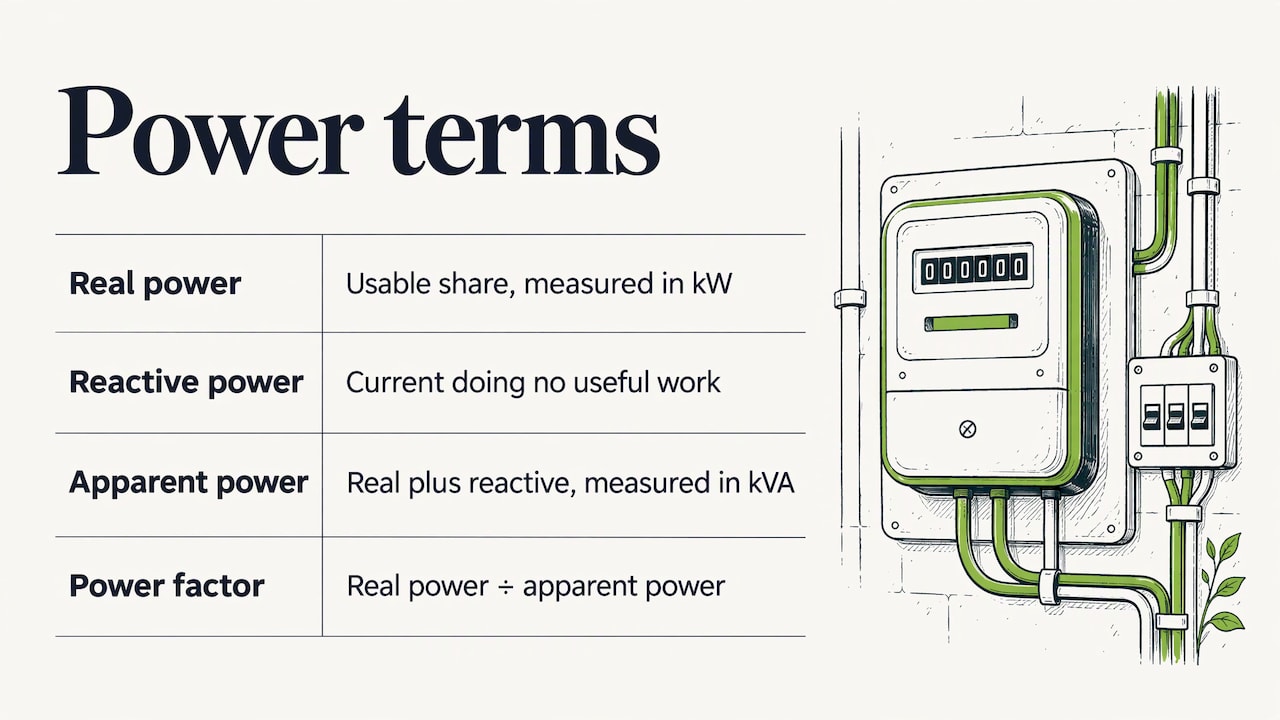
You can only turn so much off. After the thermostat, the filter and the standby loads, most households still have a refrigerator, an air conditioner and a water heater that must run. Their motors and compressors are inductive loads, which means they draw some current that does no useful work. That is reactive power, the supporting actor in the play: it never takes the lead, but the performance cannot happen without it.
The usable share is called real power, measured in kilowatts. Add the reactive part and you get apparent power, measured in kVA. The ratio of real to apparent power is the power factor:
Power factor = real power (kW) ÷ apparent power (kVA)
A lower power factor means more current moves through your wiring for the same useful work. Large commercial users are often billed for that directly. For homes, the conversation is about efficiency of the circuit, heat in the wiring and stress on equipment. Our page on power factor correction covers the math in more depth.
That is the problem the Electric Saver 1200 addresses. It is designed to optimize how your property uses power by recycling energy and feeding it back into the home or business. Our units are UL and CuL safety listed, and they are designed for easy installation.
The Perspective from our side
Most advice about a high bill ends with “use less.” That is good advice, and we repeat it ourselves: check your rate, fix leaks, service your HVAC. But a property still has to run its cooling, refrigeration, pumps and motors.
We built the Electric Saver 1200 for the load you cannot switch off. It is designed to save up to 25% on energy costs by recycling energy and feeding it back into your home or business, so you pay less for the same comfort and the same equipment.
The same device protects your whole property from surges, which is where appliance lifespan comes in. Voltage spikes wear down electronics and motors over time, and a device that smooths the supply works for you every hour of the day, not only when you remember to flip a switch.
It is made in the USA, works with any household or business voltage up to 480V, including properties with solar panels, and it is verified for safety by UL, CuL and NASA. Residential and commercial units are available, including models for single-phase and three-phase systems.
Jonica
Choosing the right Electric Saver
The right model depends on the property.
- Homes: the Residential Electric Saver 1200 is made for household electrical service. It is designed to cut your monthly bill and protect appliances.
- Businesses, shops, farms, and light industrial sites: our Power Factor Correction Products are priced from $1,499.95 to $1,999.95, one-off.
- Electricians and dealers: bulk dealer orders and wholesale packages are available for resellers and installers.
The right choice depends on your electrical service. Single-phase and three-phase systems have separate models, and our breaker size guide and installation walkthrough show what the install involves. Our products are covered by a 20-year warranty and ship fast on every order.
Surge protection is part of the same device. If you want the background on what spikes do to a home, read about whole-house surge protection.
Put the Electric Saver 1200 to work on your bill
If your two-number check shows usage is the problem and you have already trimmed the easy waste, the Electric Saver 1200 is the next step we recommend. It is built to lower what you pay for the power you need, to protect everything on your circuit, and to keep working for 20 years under warranty. Homeowners can start with the Residential Electric Saver 1200, and business owners can see the commercial power factor correction line.

We ship fast, and we are glad to help you pick the right unit for your voltage and phase.
FAQ
Why is my electricity bill so high this month?
The cause is almost always more kWh or a higher price per kWh. Compare both with the same month last year. Then check the days in the billing cycle and whether the last reading was estimated, since a correction can make one bill look inflated.
Is a $150 electric bill high?
It depends on your usage, rate and location. Divide total charges by kWh to get your rate, then compare your kWh and rate with your own bills from the past 13 months. A bill that is far above your own seasonal pattern deserves a closer look.
Does heat affect the light bill?
Yes. Cooling and heating are the largest part of most home energy use, and demand peaks on hot summer afternoons. The Department of Energy says heating can account for almost half of an average family’s winter energy bill. A well-sealed, insulated home and a serviced HVAC system soften both swings.
What uses the most electricity at home?
Heating and cooling come first, at 54% in one typical US breakdown. Appliances and electronics, water heating, refrigeration and lighting follow. Check the thermostat, HVAC filter and water heater before smaller items.
Can a device really lower a high electricity bill?
Our Electric Saver 1200 is designed to save up to 25% on energy costs by recycling energy and feeding it back into the property. It also provides whole-property surge protection and is UL and CuL safety listed, with models for homes and businesses.
Sources
- Why Is My Electric Bill So High? 8 Common Causes | APG&E
- Why Is Your Electric Bill So High? | Consumer Reports
- Why Did My Electric Bill Go Up? | Direct Energy
- Frequently Asked Questions: About Bills | Con Edison
- Understanding your bill | Public Utility Commission of Texas
- Which Appliances Use The Most Home Electricity? | Direct Energy
- What Uses the Most Electricity in Your Home? | Seattle Powerlines
- Home Energy Checklist | US Department of Energy
- Save Energy & Money Checklist | PG&E