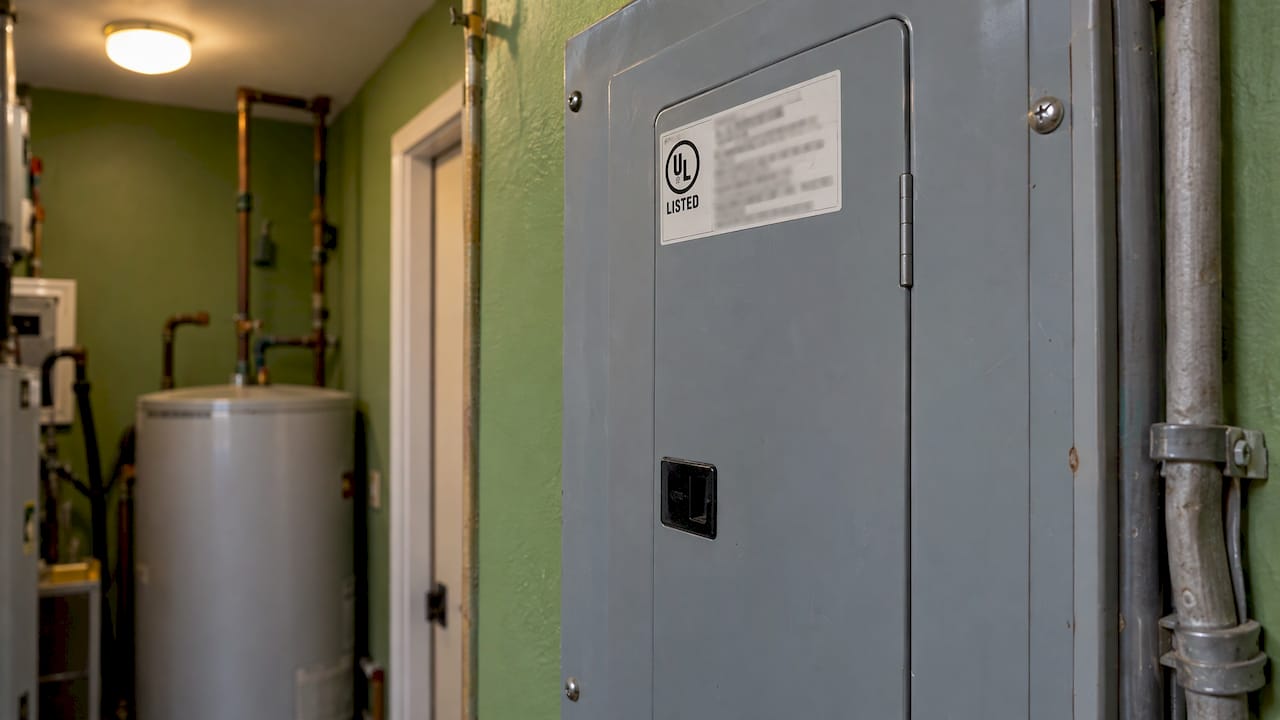
“UL Listed” means an independent laboratory, Underwriters Laboratories (now UL Solutions), tested samples of a complete product against published safety standards and found that they met them. The lab then keeps checking the manufacturer’s production. “cUL Listed” means the same kind of evaluation against Canadian standards. Together, as cULus, the marks cover both countries. If you are choosing electrical equipment for a home or a business, the label tells you the product was evaluated for fire, shock and mechanical hazards, and it tells you where to look to confirm that it is real. Our own Electric Saver 1200 line is UL and CuL safety listed, so this is a label we read closely every day.
TL;DR
- UL Listed means a complete, standalone product was tested by UL Solutions against the applicable safety standard and is checked again at the factory over time.
- cUL means the product was evaluated to Canadian (CSA) standards. cULus means both Canadian and U.S. standards.
- UL Recognized is a different mark: it is for parts built into larger equipment, not for products you install yourself.
- Check the label for the circled UL mark, the word “Certified” and a file number, then confirm the file number covers the exact model you are buying.
- Phrases such as “UL approved” or “UL compliant” are not the same as a UL Listed mark.
Table of Contents
- What “UL Listed” actually means
- How a product earns the listing
- UL Listed, Recognized, Classified and Certified: the four words you will see
- What cUL and cULus mean
- Why the mark matters for your home or business
- How to check that a UL label is real
- What happens when listed equipment is modified
- Reading the label on an energy-saving device
- Get a UL and CuL listed energy saver
- Our perspective
- FAQ
- Sources
What “UL Listed” actually means
UL Solutions describes its mark as a sign that a product has been certified to meet scientific safety, quality or security standards, and that UL keeps checking products months and years after the initial testing to make sure they still meet the requirements (UL Solutions). The key word is complete. A UL Listed product is a finished item that you can plug in, wire in or install in the field, such as a furnace, a fuse, an electrical panel board or a fire extinguisher.
UL’s own guidance explains that products certified to safety standards have been evaluated for all reasonably foreseeable safety hazards, including fire, electrical shock and mechanical hazards, and that such products are termed “UL Listed” (UL Solutions circuit breaker guide). The same guide says the mark means UL tested and evaluated representative samples and found that they meet the requirements of the applicable standard.
Two details matter in practice:
- Samples, not every unit. UL tests representative samples. That is why the follow-up inspections described below exist.
- A standard, not a general stamp. A listing is always against a specific standard for a specific kind of product. It is a statement about safety, in the way a crash rating is a statement about vehicle safety.
How a product earns the listing
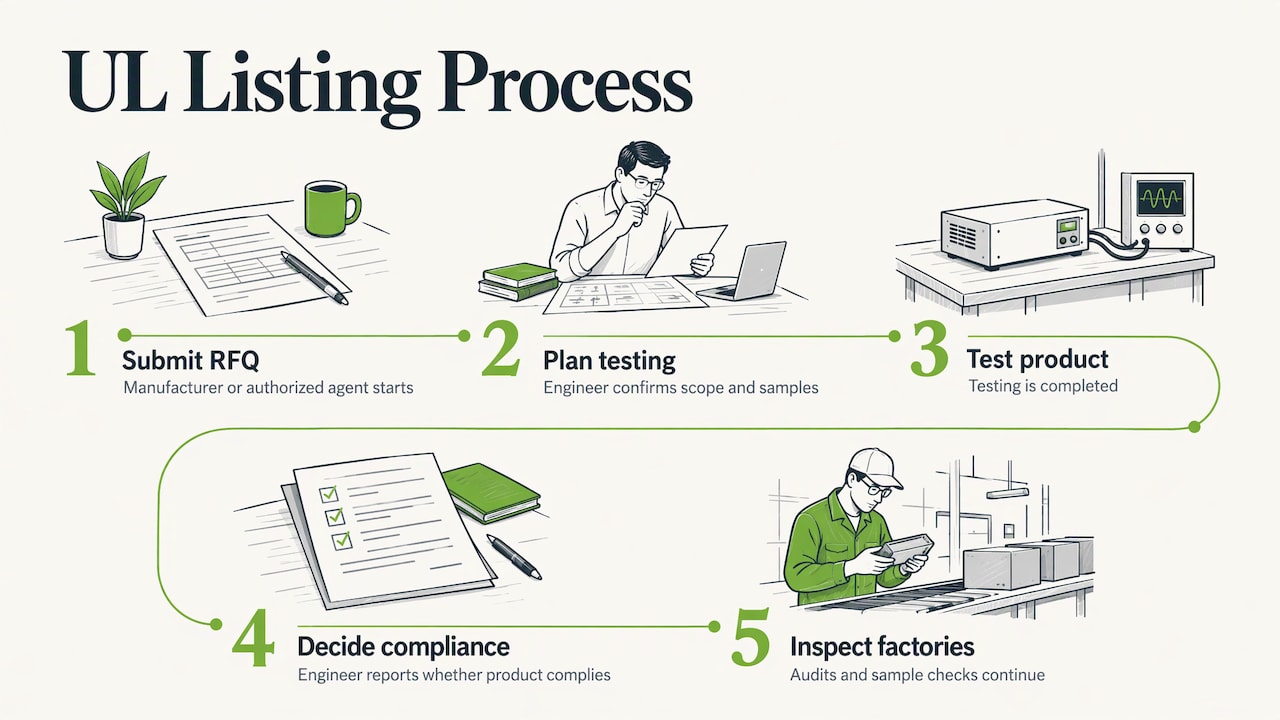
The process starts with the manufacturer. According to UL Solutions’ submittal FAQ, a manufacturer or its authorized agent submits a Request for Quote, receives a quote, and then works with an engineer who confirms the scope, test plan, sample requirements and production dates. When testing finishes, the project engineer tells the manufacturer whether the product complies (UL Solutions).
The testing does not end there. UL’s Follow-Up Services program begins once certification is achieved. It runs through factory inspections and audits at the locations authorized to make the product, to confirm that the certified product continues to comply with the original requirements (UL Solutions). UL’s service terms add that its representatives may select samples at the factory, at a place of sale or elsewhere for examination or testing (UL Solutions Follow-Up Service Terms).
For a buyer, this is the real value of the mark. It is not a one-time exam that a manufacturer passed years ago. It is a continuing relationship with an outside lab that has the right to come back and check.
UL Listed, Recognized, Classified and Certified: the four words you will see
These terms get mixed up on spec sheets and product pages. Here is the plain version.
| Term | What it covers | Typical example |
|---|---|---|
| UL Listed | A complete product evaluated for its intended use and installable in the field | Panel board, heater, whole-property surge and power equipment |
| UL Recognized | A component evaluated for use inside a larger product, installed at the factory | Power supplies, switches, motors, circuit boards |
| UL Classified | A product evaluated for a specific hazard or performance under specific conditions | Items tested for a particular property such as fire resistance |
| UL Certified | The general term that includes Listed and Classified | The modern mark wording |
UL Solutions explains that “Certified” is a general term that encompasses “Listed” and “Classified” and carries the same meaning as the traditional marks, and that all current variations of the Listing and Classification marks remain valid (UL Solutions FAQ). So a mark reading “Certified” is not a downgrade from “Listed.”
The Recognized mark is the one most often confused with Listed. UL says the Recognized Component Mark shows that a part complies with UL standards for incorporation into a larger certified end product, and that it is not certification of a complete standalone product. The mark is a stylized backward “R” and “U” and is not inside a circle, which separates it from the Listed mark (UL Solutions). Components are also evaluated under conditions of acceptability that dictate how they must be used in the final product. If you are buying something to install in a home or building yourself, you want the circled Listed or Certified mark, not a Recognized component mark.
What cUL and cULus mean
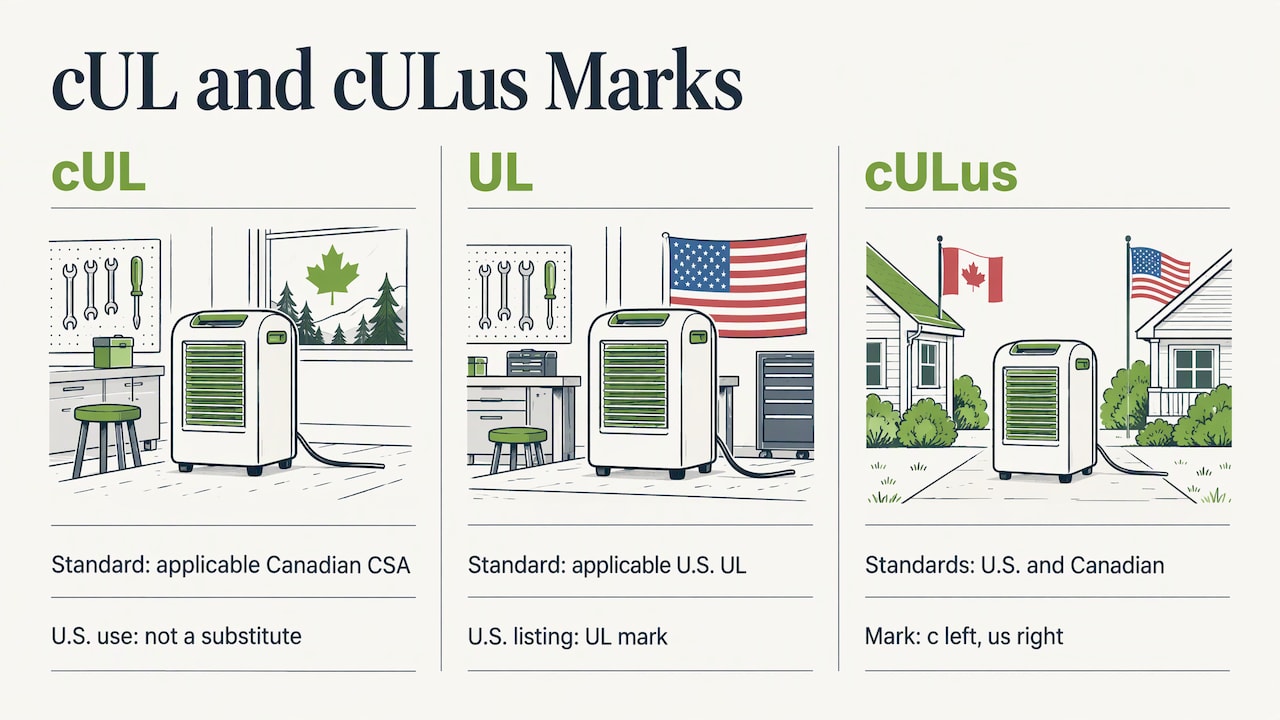
The lowercase “c” before the circled UL means the product was evaluated to Canadian standards. Eaton’s clarification document puts it simply: the C-UL mark means UL tested representative samples and determined that they meet the applicable CSA (Canadian) standard, while the UL mark means the product meets the applicable UL (U.S.) standard (Eaton).
When you see “c” on the left and “us” on the right, the product was evaluated to both sets of requirements. That is the cULus mark. For a buyer in the United States, the point to remember is this: the U.S. listing is the “UL” or “us” part. A mark with only the Canadian designation is not a substitute. UL Solutions notes that marks featuring only the “CA” country code would not be accepted within the United States, and that a UL mark without the correct region identifier does not indicate compliance with U.S. or Canadian standards (UL Solutions).
For businesses that operate on both sides of the border, or that buy for several locations, a product listed to both U.S. and Canadian requirements keeps purchasing simple. The Electric Saver 1200 is UL and CuL safety listed, which is why we point buyers in both markets to the same units.
Why the mark matters for your home or business
UL certification is voluntary: a manufacturer chooses to apply. In practice, though, inspectors, insurers and building authorities commonly ask for listed equipment, so a product without a listing can be hard to install legally or to get approved on a project. Ask your electrical inspector or your insurer what they require for your property, because local rules differ.
There is also a plain-language reason homeowners care. Electrical products sit in walls, panels and utility rooms for years. A mark that says an outside lab examined the fire and shock risks, and that the lab continues to audit the factory, is a practical signal before you wire something into your property.
A UL mark is not the same thing as a CE mark. UL Solutions says most CE-marked products are not required to be third-party certified, are not subject to ongoing factory surveillance, and may not comply with U.S. product safety standards, so they are not considered Listed under U.S. model codes (UL Solutions Code Authorities). If a product is imported and carries only a CE mark, it has not earned a U.S. listing.
How to check that a UL label is real
A label is easy to copy. A verified listing is much harder to fake. Use this routine whenever you are buying electrical equipment.
- Read the mark itself. The basic UL mark is the familiar UL lettering inside a circle, the word “CERTIFIED” and the registered trademark symbol. The smart version can include a QR code that sends a scanner to a certification page with details about the product (UL Solutions FAQ).
- Find the identifying marking. UL says Listed products must carry a marking identifying the Listed company: a company name, trade name or trademark, or the Listee’s UL file number. It appears on the product or on the smallest unit container it is shipped in (UL Solutions Code Authorities).
- Match the file number to the model. A file number tells you a record exists. You also want that record to belong to the company selling the product and to cover the exact model, not just a sibling product from the same maker.
- Watch the wording. “UL approved,” “UL compliant” and “built to UL standards” describe intentions, not a UL certificate. Look for “Listed” or “Certified” with the mark.
- Match the mark to the use. For a unit installed on your property, you want a Listed (or Certified) mark rather than a Recognized component mark.
If you are buying from us, you can ask for the model’s listing details at any point, and the product pages state its UL and CuL listing.
What happens when listed equipment is modified
The UL mark is the manufacturer’s declaration that the product was built to all applicable requirements and complied when it left the factory. UL Solutions adds that if a product is modified after it leaves the factory, only a UL Field Evaluation can determine whether the modified product complies (UL Solutions Code Authorities).
This is why installers avoid drilling, rewiring or re-housing listed equipment. Even choices that seem minor, such as putting a unit in a different enclosure outdoors, can change the picture. If you are weighing outdoor installations, NEMA enclosure ratings show how enclosure type relates to weather exposure. As a rule, install listed equipment as it ships and follow its instructions.
Reading the label on an energy-saving device
Energy-saving and power-quality devices connect to your electrical system, so a UL and CuL listing is the first thing to look for on the label. Treat the safety listing as the entry ticket. Then look at the practical fit for your property:
- Voltage and phase. Check that the unit matches your service: single-phase for most homes, three-phase for many commercial buildings.
- Warranty. A long warranty tells you how long the maker expects to stand behind the unit.
- Where it is made. Made-in-USA production allows factory follow-up inspections to take place domestically.
- Your property type. Homes with solar panels and commercial sites with larger loads both need a unit rated for their voltage.
The Electric Saver 1200 is built for exactly this checklist. It is UL and CuL safety listed, designed for easy installation, made in the USA and compatible with any household or business voltage up to 480v, including properties with solar panels. Models are available for single-phase and three-phase systems, and the line carries a 20-year warranty.
Get a UL and CuL listed energy saver
If you want to lower your electric bills with a device that carries the listings described above, the Electric Saver 1200 is our answer for homes. It is designed to save up to 25% on energy costs by recycling and optimizing unused energy, and it also provides whole-property surge protection that helps extend the life of your appliances. You can see the residential unit on the Residential Electric Saver 1200 page.
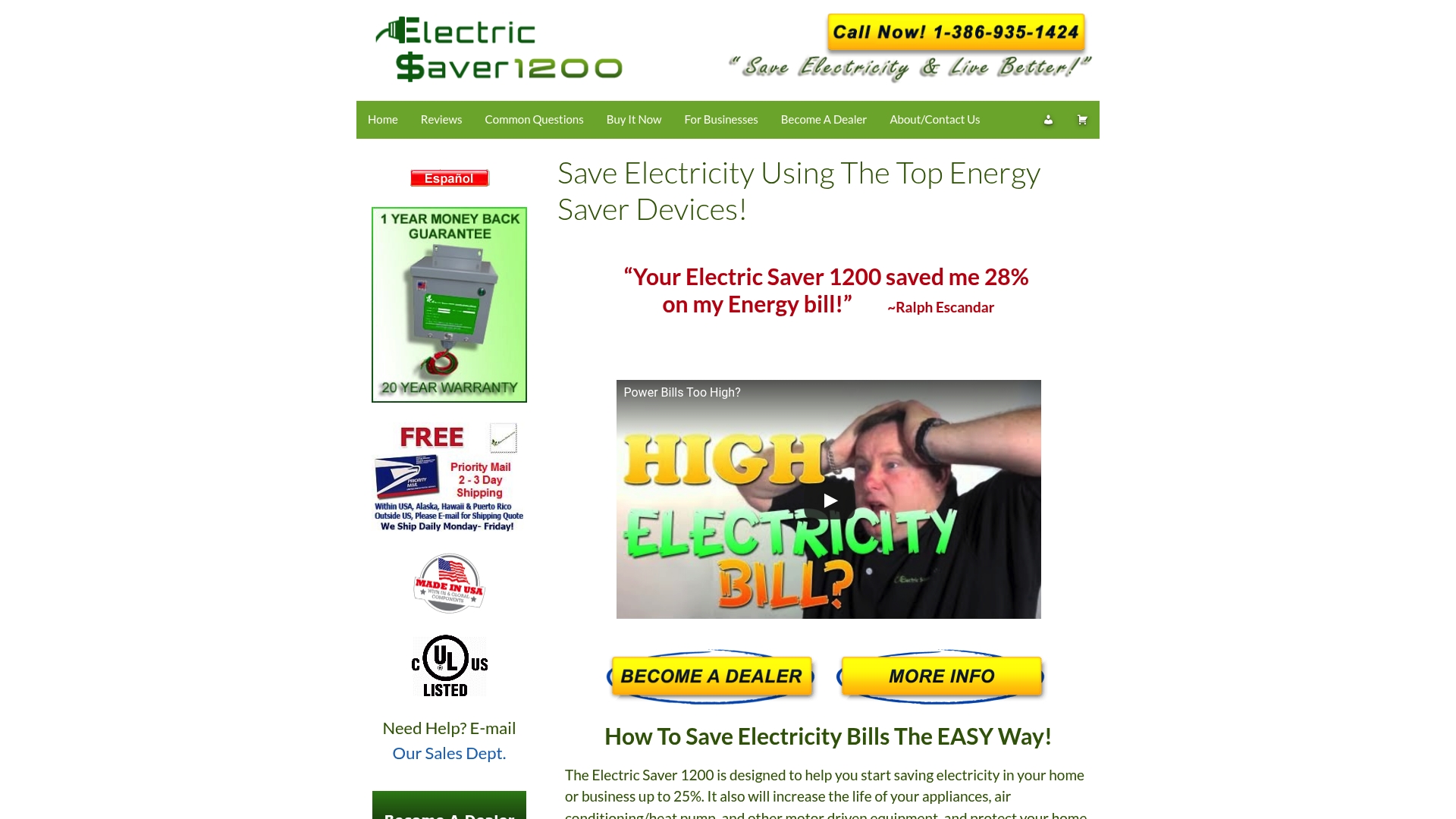
Business owners, electricians and dealers can look at our Power Factor Correction Products, listed at $1,499.95 to $1,999.95 as a one-off price. Dealer and bulk orders are available, and all orders ship fast. For an overview of the whole range, start at electricsaver1200.com.
Our perspective
We read the UL mark the way an electrician does: as the first question, not the last one. Before anyone asks how much a device can save, they should be able to answer a simpler one: has an independent lab examined this for fire and shock risk, and does it keep auditing the factory?
That is why we put the UL and CuL listing at the front of how we describe the Electric Saver 1200. A device that connects to a home’s or a business’s whole electrical system should arrive with a mark you can read on the label and trace back to a file.
Our energy savers are made in the USA, designed for easy installation, and built to work with any household or business voltage up to 480v, solar-equipped properties included. We stand behind them with a 20-year warranty because we expect them to be in service for a long time, quietly protecting appliances and trimming the electricity bill.
If you take one thing from this page, take the routine: read the mark, find the file number, confirm it covers the model. Do that with every electrical product you buy.
Jonica
FAQ
What does UL Listed mean?
It means a complete product was tested by UL Solutions against the applicable safety standard, covering hazards such as fire, electric shock and mechanical injury. The manufacturer’s production is then audited through UL’s follow-up program. It is a safety certification, not a brand ranking.
What does cUL Listed mean?
The “c” means the product was evaluated to Canadian (CSA) safety standards by UL. If the mark also has “us,” the product was evaluated to both Canadian and U.S. requirements. In the United States, look for the “UL” or “us” designation on the label.
What is the difference between UL Listed and UL Recognized?
Listed is for finished products that can be installed in the field. Recognized is for components, such as power supplies or switches, that are built into other equipment at the factory under specific conditions of acceptability. A Recognized part is not certification of a standalone product.
How can I tell if a product is genuinely UL Listed?
Look for the circled UL mark with the word “Certified,” plus a company name, trademark or UL file number on the product or its smallest shipping container. Then confirm that the file number covers the exact model you are buying. Wording such as “UL approved” does not replace the mark.
Is UL certification required by law?
It is voluntary for manufacturers. Many inspectors, insurers and building authorities, however, ask for listed equipment on installations, so check what your local inspector or insurer requires before you buy.
Sources
- Look for the UL safety Mark before you buy, UL Solutions
- Molded Case Circuit Breaker Marking and Application Guide, UL Solutions
- Product Submittal Process FAQ, UL Solutions
- Follow-Up Services, UL Solutions
- Follow-Up Service Terms, UL Solutions
- FAQ: Enhanced and Smart UL Certification Mark, UL Solutions
- The UL Component Recognition Classification, UL Solutions
- Product Certification Marks for Firestop Systems, UL Solutions
- C-UL certification mark clarification, Eaton
- Code Authority FAQs, UL Solutions Code Authorities
- NEMA enclosure ratings