Commercial energy efficiency means getting the same level of service from a building while using less energy. The most reliable path has three parts: measure how the building performs today, fix the biggest loads first (usually heating, cooling and ventilation), and then correct how the electrical system itself uses power. That last part is where our Power Factor Correction Products work: they are built for commercial properties, and our devices are UL and CuL listed and compatible with voltages up to 480v.
TL;DR
- Efficiency is a ratio, not a bill total: the same service for less energy. Benchmark first, then act.
- HVAC is the largest single load, at about 40% of commercial energy use in the United States.
- Low-cost operational fixes come first, equipment upgrades second, and whole-building design delivers the deepest savings.
- Federal tax deductions under Section 179D can offset part of qualifying upgrade costs.
- Our commercial power factor products are priced from $1,499.95 to $1,999.95 and are designed to lower electricity costs and protect equipment.
Table of Contents
- What commercial energy efficiency actually means
- Where commercial buildings use their energy
- A practical order of operations
- What it costs and what pays back
- Incentives and tax deductions in the United States
- Designing efficiency into the building
- Our view: the electrical system deserves a line in every efficiency plan
- Add the electrical layer to your plan
- FAQ
- Sources
What commercial energy efficiency actually means
The working definition comes from an ACEEE paper on building metrics: providing a constant level of energy service while using less energy. The phrase “constant level of service” matters. A warehouse that uses little power because it is half empty is not efficient. It is simply quiet.
That is why a single number rarely tells the story. Energy use intensity (energy per square foot) is the most common metric, but the same ACEEE paper cautions that low energy use can reflect very effective operations, or very low tenant demand, rather than efficient systems. In practice, building owners look at several indicators together: energy per square foot, energy per unit of output or occupancy, peak demand, and the quality of the electrical supply.
How buildings are benchmarked
The benchmark most U.S. owners know is the ENERGY STAR score. According to EPA’s Portfolio Manager technical reference, the score runs from 1 to 100 on a percentile basis. A score of 50 means the building performs better than half of its peers, and a score of 75 or higher puts it in the top quartile. The score is based on source energy use intensity.
A benchmark gives you a starting position and a way to show progress. It does not tell you which equipment to change. For that you need an audit.
Where commercial buildings use their energy
Heating, cooling and ventilation dominate. The U.S. Department of Energy’s Better Buildings program reports that commercial space conditioning accounts for about 40% of total commercial energy use, roughly 7.0 quads of primary energy a year. Academic work points the same way: a research chapter from Eindhoven University of Technology puts HVAC at 39% of energy use in U.S. commercial buildings and notes that high-performance HVAC equipment can deliver 10% to 40% savings, while whole-building design can reach 40% to 70%.
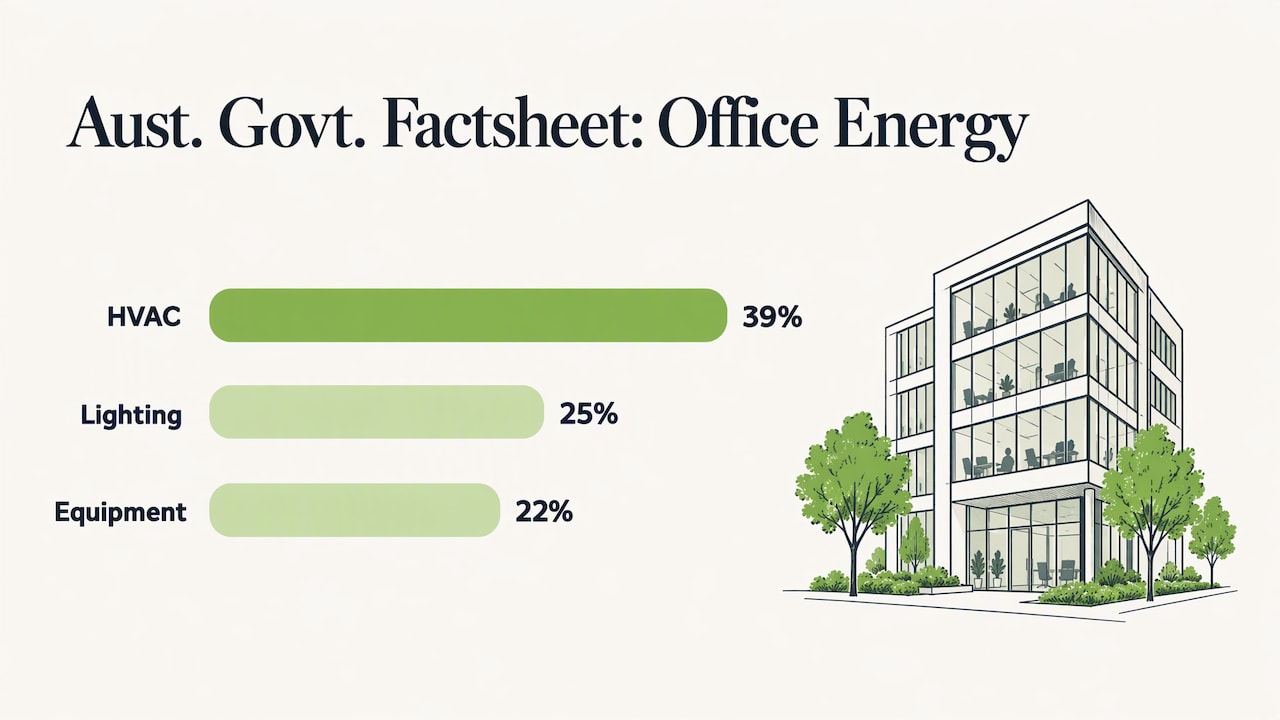
The remaining load splits between lighting, plug and process equipment, refrigeration, and motors. An Australian government factsheet gives a typical office breakdown of 39% HVAC, 25% lighting and 22% equipment. Your building will differ, and the same factsheet notes that results vary widely with equipment, design, orientation and system type. That variation is the reason to measure your own site rather than rely on averages.
If heating and cooling are your largest load, the way the system is sized and commissioned matters as much as the equipment itself. Measured commissioning of heat pump and ventilation systems shows how verified run-time data can show whether a system is performing as designed.
A practical order of operations
Most efficiency programs that work follow the same sequence. Each step builds on the one before.
1. Audit before you spend
An energy audit is, in the words of Ireland’s SEAI Energy Audit Handbook, an inspection, survey and analysis of energy flows to find savings opportunities. It runs in two phases: preparation and pre-analysis of bills and drawings, then a site visit and report. The European LEAP4SME booklet adds that a good audit quantifies each opportunity and ranks it using simple payback, net present value, internal rate of return or life cycle cost.
Bring twelve months of utility bills. Look at the demand charge, the energy charge and any line that mentions power factor or reactive demand. Those lines point to electrical-system losses that no amount of insulation will fix.
2. Start with no-cost operational changes
New Zealand’s EECA publishes a commercial building checklist covering operations, maintenance, occupant education, building envelope and equipment upgrades. Many of its measures cost nothing: running HVAC only during occupancy hours, repairing damper seals, and adjusting diffusers to avoid overcooling. The U.S. ENERGY STAR guidance follows the same logic of starting with low-cost measures and using early savings to fund larger projects.
3. Upgrade equipment where the audit points
Typical candidates are high-efficiency HVAC, LED lighting with controls, variable-speed drives on motors, and envelope work such as sealing and insulation. DOE’s Advanced Energy Retrofit Guides are written for specific building types, including office, retail, grocery, K-12 schools and healthcare, and include methods for calculating cost-effectiveness.
4. Correct the electrical system itself
This is the step most efficiency checklists skip. Motors, compressors, HVAC units, transformers and fluorescent or older lighting ballasts draw reactive power. Reactive power does no useful work, but it adds current to the system. More current means more heat, more stress on conductors and equipment, and a lower power factor.
The simplest way to picture it: reactive power is the supporting actor in the play. The audience pays to see the lead, real power, but the stage still has to hold both.
The relationship is compact:
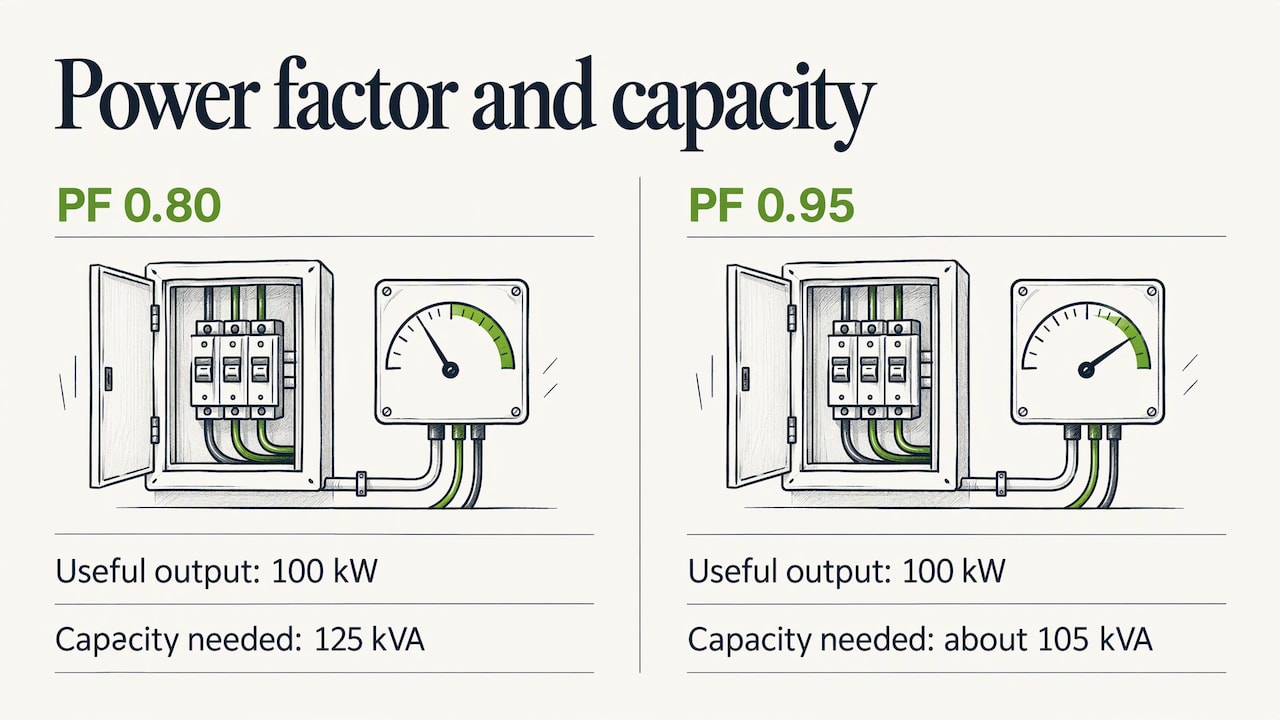
Apparent power (kVA) = real power (kW) ÷ power factor
A building at 0.80 power factor needs 125 kVA of capacity to deliver 100 kW of useful work. At 0.95 it needs about 105 kVA. The difference is capacity you pay for and equipment you load without getting output. Power factor correction brings that figure closer to 1.0.
This is the territory of our Power Factor Correction Products, which are priced from $1,499.95 to $1,999.95 as a one-off purchase. They are made in the USA, designed for easy installation, available for single-phase and three-phase systems, and compatible with any business voltage up to 480v, including properties with solar panels.
5. Verify and keep the savings
Savings that are never checked tend to fade. Mauritius’s national energy efficiency guidelines stress commissioning and measurement and verification so that measures keep working as expected, and they include simple payback and life cycle cost tools. In practice: compare monthly bills against a baseline, adjust for weather and occupancy, and re-benchmark each year.
What it costs and what pays back
Payback depends on the measure. Operational fixes pay back almost immediately because they cost little. Equipment and envelope projects take longer but last for decades. SEAI’s handbook notes that improving energy efficiency often represents the lowest-risk and most cost-effective investment for companies looking to improve their performance. The ERIA technical guidelines for commercial buildings add that efficiency is far more cost-effective at cutting emissions than renewables alone, and that measures need not be expensive or technically advanced.
A simple payback calculation is enough for a first pass:
Simple payback (years) = installed cost ÷ annual savings
For example, a $1,800 device that lowers a bill by $900 a year pays back in two years. That figure is a worked illustration of the arithmetic, not a promise about any particular building. Your own bills decide the real number.
| Measure | Typical cost level | Where savings show up |
|---|---|---|
| HVAC scheduling and damper repairs | Low or none | Energy charges |
| LED lighting and controls | Moderate | Energy charges, cooling load |
| Power factor correction | Moderate, one-off | Electrical losses, equipment load, power-factor-related charges |
| HVAC replacement | High | Energy and demand charges |
| Envelope upgrades | High | Heating and cooling load |
Incentives and tax deductions in the United States
Federal Section 179D provides a deduction for energy-efficient commercial building property. DOE reports that for 2025 the deduction ranges from $0.58 to $5.81 per square foot, with the highest amounts available when prevailing wage and apprenticeship requirements are met. DOE also hosts a 179D deduction overview explaining what qualifies. Rules and amounts change, so confirm current figures with your tax adviser before you plan around them. State programs and utility rebates also exist and vary by location; your utility’s business program page is the place to check.
Designing efficiency into the building
Efficiency is cheapest when it is planned early. For new construction or major renovation, pairing efficient design with on-site generation lets you size a system for a smaller load. Commercial solar and storage planning is one example of integrating efficient energy use into building operations. Our devices work with solar-equipped properties, so an efficiency measure and a generation project do not have to be sequenced around each other.
Our view: the electrical system deserves a line in every efficiency plan
We talk to owners every day who have replaced lighting, tuned the thermostat schedule and still see a stubborn electric bill. The next place to look is how the building draws power.
Our Electric Saver 1200 line is designed to recycle energy and feed it back into the property, which can reduce electricity costs by up to 25%, extend the life of appliances and provide surge protection for the whole property. Commercial buyers choose from our power factor correction products for single-phase and three-phase systems, compatible with voltages up to 480v.
Safety matters as much as savings in a commercial setting. Our devices are UL and CuL listed, and they carry a 20-year warranty, so the decision is one you make once.
The best efficiency plan is layered: operations, equipment, then the electrical system. We make the third layer simple to add.
Jonica
Add the electrical layer to your plan
If your audit or utility bill points to electrical losses, our Power Factor Correction Products are made for commercial properties, from $1,499.95 to $1,999.95. They are built in the USA, UL and CuL listed, designed for easy installation, and backed by a 20-year warranty, with fast shipping on all orders.

For smaller properties, the Residential Electric Saver 1200 brings the same approach to homes. Dealers and electricians can also order in bulk through our main site.
FAQ
How much of a commercial building’s energy goes to HVAC?
About 40% in the United States, according to the Department of Energy. Individual buildings vary with climate, design and equipment, so your own submetering or audit data gives the most useful figure.
What does an ENERGY STAR score of 75 mean?
It means the building performs better than at least 75% of comparable buildings, placing it in the top quartile of energy performance. EPA describes the score on a 1 to 100 percentile scale, based on source energy use intensity.
What is the first step in commercial energy optimization?
Collect twelve months of utility bills and benchmark the building. Then audit the largest loads and correct the electrical supply side, including power factor, alongside operational and equipment measures.
Can a business deduct the cost of efficiency upgrades?
Often, yes. Section 179D offers a per-square-foot federal deduction for qualifying energy-efficient commercial building property, per the Department of Energy. Eligibility depends on the project and building, so confirm details with a tax professional.
Sources
- Portfolio Manager Technical Reference: ENERGY STAR Score
- ENERGY STAR for buildings
- Metrics for Energy Efficient Buildings (ACEEE, 2016)
- Space Conditioning, Better Buildings Solution Center
- HVAC Energy Breakdown factsheet
- HVAC systems for energy efficiency, Eindhoven University of Technology
- SEAI Energy Audit Handbook
- LEAP4SME Energy Audits Booklet
- EECA Commercial Building Checklist
- Advanced Energy Retrofit Guides, Department of Energy
- ERIA Technical Guidelines for Commercial Buildings
- Mauritius Energy Efficiency Guidelines
- Tax deduction calculations, Department of Energy
- 179D Tax Deduction, Department of Energy