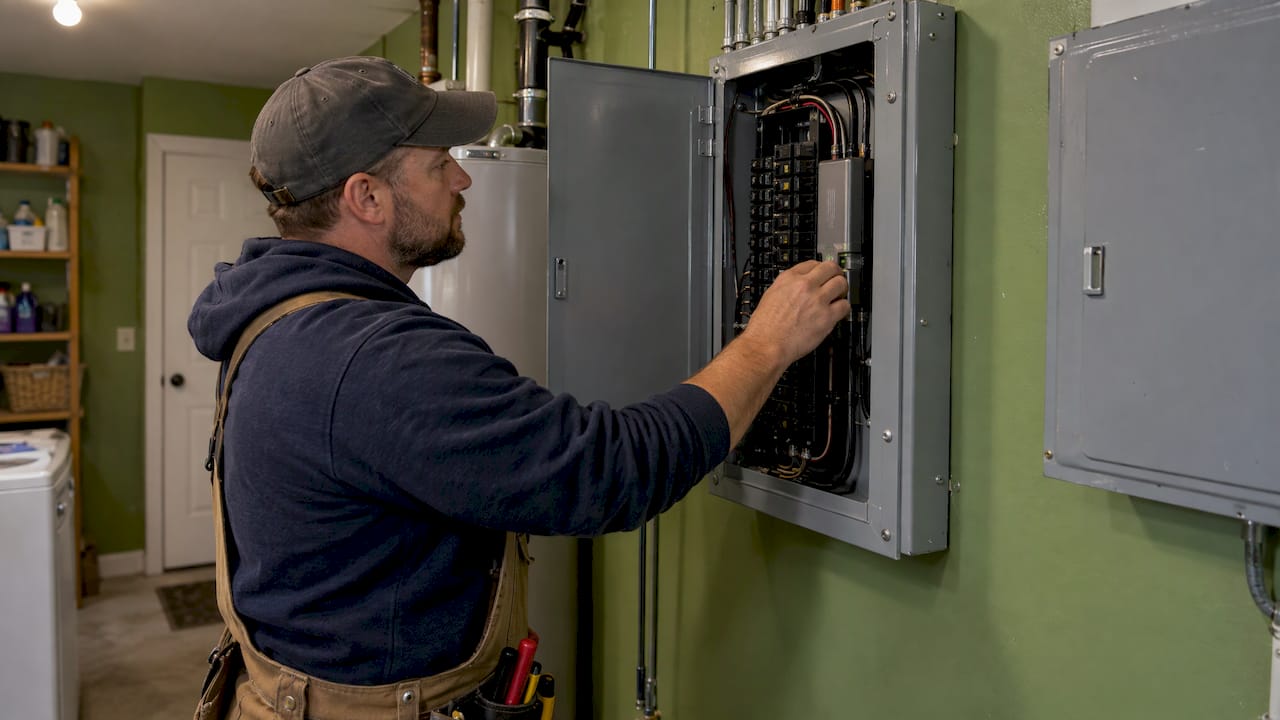
Home power surge protection works best in layers: a device at the main electrical panel that handles large spikes for every circuit, plus plug-in protectors for sensitive electronics. The panel-level device is hard-wired by a licensed electrician, and it covers refrigerators, HVAC equipment, washers and everything else on your circuits, not just what you remember to plug into a power strip. This guide explains what causes surges, how to tell whether your house already has protection, what to look for when you choose a device, and how to keep it working for years.
TL;DR
- A surge is a short spike in voltage. It can come from outside (lightning on nearby lines) or from inside your home (motors in appliances switching on and off).
- Whole-house protection is installed at the main panel by a licensed electrician and covers all circuits. Plug-in protectors add a second layer at the outlet.
- The 2020 National Electrical Code requires a listed Type 1 or Type 2 surge protective device in new or renovated homes, so older homes often have none.
- Look for UL certification, a rating that matches your service, and an indicator light you can check. Have the device inspected on a regular schedule and after a major storm.
- Our Electric Saver 1200 is built to pair energy savings with whole-property surge protection, in residential and commercial models.
Table of Contents
- What a power surge is and where it comes from
- Do you need surge protection at home?
- How to tell whether your house already has surge protection
- What whole-house protection looks like and where it goes
- Why layers work better than a single device
- How to choose surge protection for your appliances
- Keeping protection working
- Surge protection and your electric bill
- Our perspective on protecting a whole property
- Put whole-property protection to work
- A simple plan for your home
- FAQ
- Sources
What a power surge is and where it comes from
A power surge is a brief jump in voltage above the level your appliances are built to handle. Surge protective devices (SPDs) exist to guard installations and sensitive electronics from these transient overvoltages, which can cause instant failure or damage that only shows up over time. That second part matters: a surge does not always kill a device on the spot. Repeated small spikes can quietly shorten the life of a motor, a control board or a television.
Surges have two broad sources.
External surges
These arrive from outside the house. Switching on utility transformers and motors, and indirect lightning strikes on nearby overhead power or telephone lines, can send a spike down the line into your service. A lightning bolt does not have to hit your house to affect it.
Internal surges
Many surges start inside your walls. Motors turning on and off in appliances such as refrigerators, dryers, HVAC fans and garage door openers generate small spikes every day. Because they are small and frequent, they are easy to overlook, and they are one reason protection at the panel is worth considering even in regions with little lightning.
Do you need surge protection at home?
If your home has valuable electronics, major appliances or HVAC equipment, protection at the panel is a sensible investment, and for newer construction it is a code matter. The 2020 National Electrical Code (NEC) requires listed and approved Type 1 or Type 2 surge protective devices in all new or renovated homes. Your local jurisdiction adopts its own edition of the code, so your electrician or building department can tell you what applies where you live.
The code sets a floor, not a ceiling. Think about what sits behind your panel:
- A refrigerator, freezer, washer and dryer that run on motors and control boards.
- A furnace or heat pump with electronic controls.
- Televisions, computers, routers, smart-home hubs and chargers.
- Home office or home business equipment that you cannot afford to lose.
Replacing any one of these costs far more than most protective devices, which is why homeowners who have been through a storm or a flicker-and-fail event tend to add protection afterward. Doing it before the event is simpler.
How to tell whether your house already has surge protection
Start with the age of the home. SPD requirements were first introduced in the 2020 NEC and the 2021 International Residential Code. A house built before those editions probably has no panel-level device unless a previous owner added one, or unless work such as a panel replacement or major electrical upgrade triggered compliance with the code adopted at the time.
Then look at the panel itself:
- Check the main breaker panel. Open the cover of the room or utility area where the panel sits (do not remove the inner dead-front cover; that is electrician work). A surge device is often a small box mounted beside or on the panel, with wires running into it.
- Look for indicator lights. A typical whole-house unit has status lamps. A photo of one installed on a panelboard shows two green lamps indicating the unit’s metal-oxide varistors are still functional.
- Check the meter base. Some utilities and installers fit a protector at the meter socket.
- Ask an electrician. The Electrical Safety Foundation International recommends that a basic home electrical inspection check for appropriate surge suppression, and in areas with a lot of lightning, consider a surge arrester at the fuse box or breaker panel.
Plug-in strips do not count as whole-house protection, however good they are. They guard only what is plugged into them.
What whole-house protection looks like and where it goes
Whole-house protectors are installed directly at the main electrical panel and hard-wired by a licensed electrician. They range from mouse-sized to pizza-box-sized, so the size alone tells you little about quality.
You will see these device types named in the code and in product literature:
| Type | Where it connects | What it addresses |
|---|---|---|
| Type 1 | Permanently connected, inside or outside the home | External and internal surges |
| Type 2 | Permanently connected near the breaker box | External and internal surges |
| Type 3 | Point of use, such as a plug-in strip | Used together with Type 1 or Type 2 to meet 2020 NEC requirements |
The NIST recommended practice guide on surges adds a useful detail. A protector at the service entrance panel protects one-link appliances in the house but not two-link appliances, meaning those connected through both power and a communication line such as cable, phone or Ethernet. Installation at the service entrance generally requires an electrician unless local code allows otherwise.
Why layers work better than a single device
Whole-home protection intercepts large spikes at the panel and secures every circuit. Plug-in protectors then provide a second, targeted defense for sensitive electronics. According to This Old House, even very effective panel devices can let some excess voltage through, up to about 15%, which is why it recommends supplemental plug-in protection for sensitive equipment.
In practice, a layered setup looks like this:
- Layer one, the panel: a hard-wired device that handles the big events and protects hardwired loads such as the furnace, water heater, well pump and electric dryer.
- Layer two, the outlet: a plug-in protector on the home theater, the desk setup and the router and modem, which also have data lines running in.
This also fits the NEC’s thinking: Type 3 devices are meant to work with a Type 1 or Type 2 device, not in place of one.
How to choose surge protection for your appliances
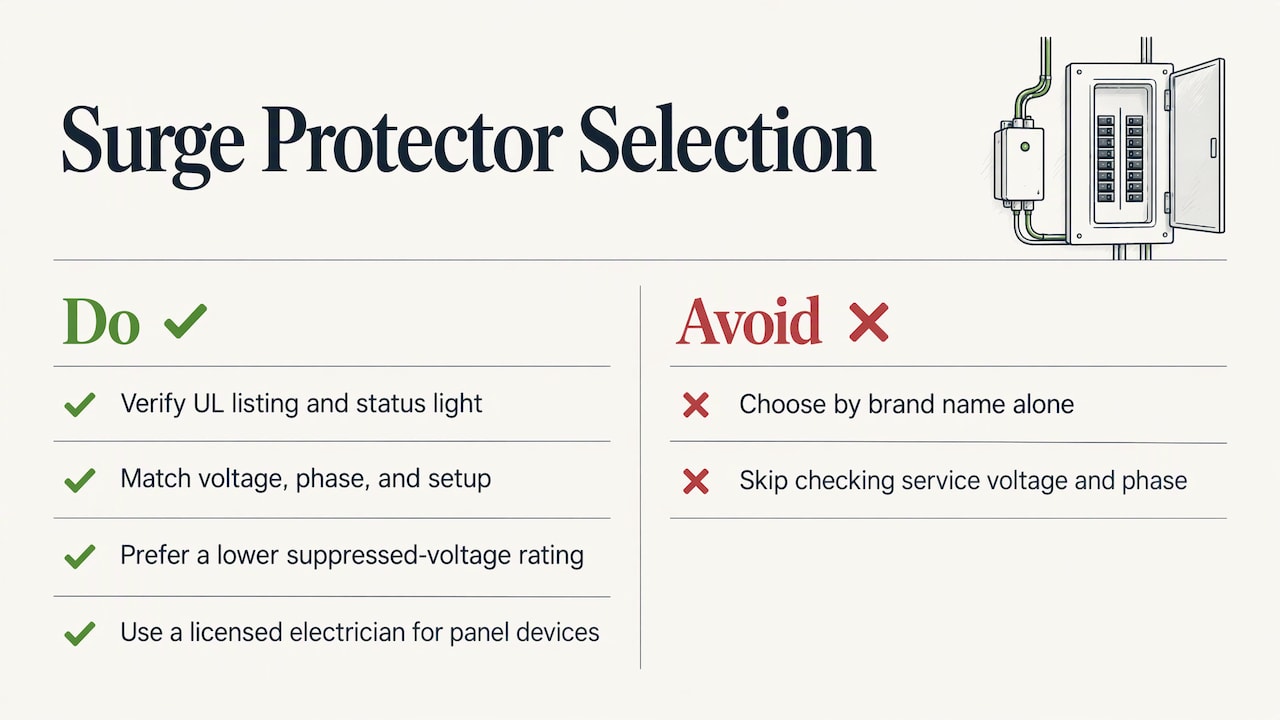
Use a short checklist rather than a brand name.
Certification. Look for UL certification. It confirms the manufacturer has met safety standards for fire, electrical shock and personal injury hazards. On our own devices, we list UL and CuL safety listing.
Electrical rating. Make sure the electrical rating matches the devices you are connecting. For a whole property, that means the voltage and phase of your service. Homes are usually single-phase; many commercial buildings are three-phase, so check which you have before ordering.
Suppressed voltage rating. UL notes that a lower suppressed voltage rating is preferred, because it indicates better surge protection capability.
Indicator. Choose a unit with a visible status light so you can confirm it is working without tools.
Installation. Panel-level devices need a licensed electrician. A product designed for straightforward installation saves your electrician time.
Compatibility. If you have solar panels or a higher-voltage commercial service, confirm the device supports your setup before you buy.
Keeping protection working
Surge protectors have finite lifespans, and they can wear out without visible signs. The practical routine, according to This Old House, is to check indicator lights regularly, replace plug-in units every two to three years or after major surge events, and have whole-home systems inspected annually.
After a nearby lightning event, have the device checked. A thorough check includes visual inspection for burn marks, discoloration, melted components or tripped indicators, electrical testing, and a review of how connected equipment behaves. Leave the testing to your electrician.
A few habits at the outlet help too. UL Solutions advises limiting heating products to one per power strip because they draw more current, and overloading a strip can trip a breaker. Space heaters and toasters belong on a wall outlet, not on a protector meant for electronics.
Surge protection and your electric bill
A pure surge protector is a safety device, not a savings device. The surges it handles last only a few milliseconds, so any incidental savings would be insignificant. That is the reason we built the Electric Saver 1200 as a different kind of product: it is designed to combine surge protection with an energy-optimizing function, so a single installation addresses both the protection side and the monthly bill side.
Our perspective on protecting a whole property
Most homeowners think about surges only after something fails. We think about them as a property-wide question: every circuit, every appliance, every day, not only the afternoon a storm rolls through.
That is why the Electric Saver 1200 is designed around the whole property rather than a single outlet. It is built to reduce what you pay on your electric bill, with savings of up to 25% as our claim, to help extend the life of the appliances on your circuits, and to provide surge protection in the same unit. It recycles energy by feeding it back into the home or business, instead of letting it go unused.
We make it in the USA. The devices are UL and CuL safety listed, and verified for safety and effectiveness by UL, GE and NASA. They are compatible with any household or business voltage up to 480V, including properties with solar panels, and we offer models for single-phase and three-phase systems. A 20-year warranty stands behind them, and we ship fast.
Pair a panel-level device with good plug-in protection for your most sensitive electronics, and you have a setup that protects your investment from both directions.
Jonica
Put whole-property protection to work
If you want one device to work on your surge exposure and your electric bill together, the Electric Saver 1200 is our answer for homes, and our commercial range covers businesses. Both are designed for easy installation by your electrician and made in the USA.
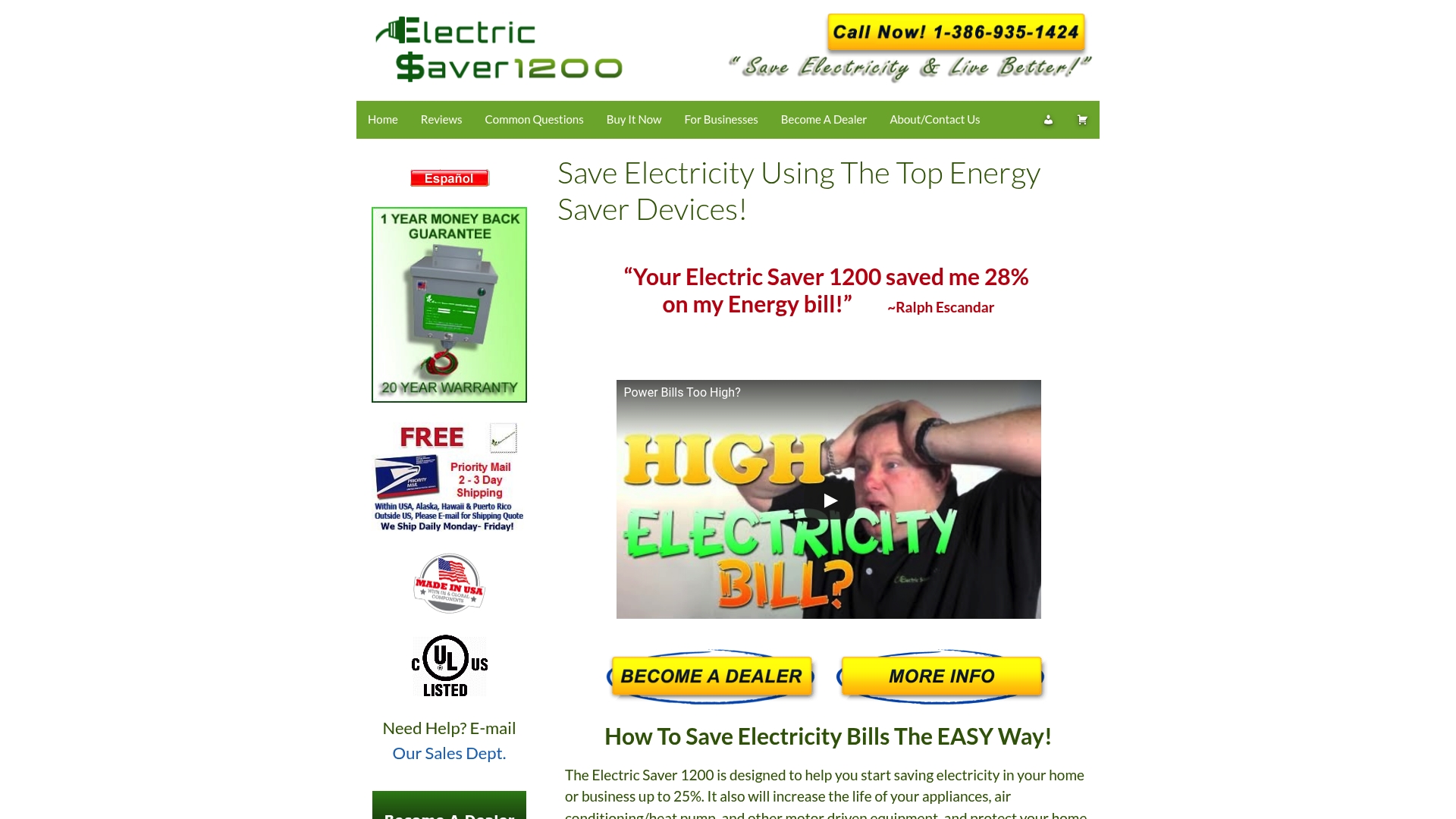
Homeowners can see the Residential Electric Saver 1200 and order online. Businesses and dealers can look at our Power Factor Correction Products, published at $1,499.95 to $1,999.95 per unit, one-off. For an overview of the full range, visit our energy saver devices page.
A simple plan for your home
- Find out your home’s build year and whether a panel-level device is already installed.
- Confirm your service voltage and phase, and whether you have solar.
- Have a licensed electrician install a UL-listed device at the main panel.
- Add plug-in protection for the electronics that matter most, including anything with a data line.
- Put an annual inspection on the calendar, and check indicator lights after storms.
That sequence covers the whole property in an afternoon of electrician time, and the rest is occasional maintenance.
FAQ
Do I need a surge protector at home?
In most homes, yes, especially if you own major appliances or sensitive electronics. The 2020 NEC requires a listed Type 1 or Type 2 device in new or renovated homes, and surges also come from motors inside your own house. A panel-level device covers every circuit at once.
How do I know if my house has surge protection?
Check your main panel for a small box with status lights, and consider the age of the home: SPD requirements began with the 2020 NEC. If you are unsure, ask a licensed electrician to include surge suppression in a basic home electrical inspection.
What does a whole-house surge protector look like?
It is a compact box mounted at or beside the main breaker panel, usually with indicator lights, and sized anywhere from a mouse to a pizza box. It is hard-wired into the panel, so it looks different from a plug-in power strip.
Can I install a whole-house surge protector myself?
Installation at the service entrance generally requires an electrician unless local code allows homeowners to do it. Panel work carries shock risk, so we recommend a licensed electrician for the job.
Will surge protection lower my electric bill?
A standalone surge protector will not, because surges last only milliseconds. The Electric Saver 1200 is designed to do both: it provides surge protection and is built to cut energy costs, with savings of up to 25% as our claim.
Sources
- Surge Protective Devices (SPD), IET consumer guidance
- What is a surge protector
- Surge Protective Devices, ESFI
- Indoor Electrical Safety Check Booklet, ESFI
- After the Strike: Code-Based Inspections for Residential Safety
- What to Know About Whole House Surge Protectors, This Old House
- Whole House Surge Protector photo, Wikimedia Commons
- NIST Special Publication 960-6: Surges Happen!
- Guide to Power Strips and Surge Protectors, UL Solutions
- Consumers Beware, JEA