
A typical U.S. small business pays roughly $600 to $1,200 a month for electricity, depending mostly on where it operates. The bill is not just kilowatt-hours times a rate. It also includes demand charges, fixed fees and sometimes power-factor adjustments, and each of those can be managed. This guide shows what businesses pay, how the bill is built, and which levers actually lower it.
TL;DR
- The U.S. commercial average was 14.47¢/kWh in August 2026, but state averages range from under 9¢ to over 40¢.
- Regional average commercial bills in 2024 ran from about $616 to $1,207 a month.
- Your bill has several parts: energy (kWh), demand (kW), fixed charges and adjustments. Cutting costs means working on each part.
- Schedule changes, equipment upgrades, rate selection and power factor correction are the main levers.
- Our Electric Saver devices are designed to reduce electricity costs by up to 25% while adding whole-property surge protection.
Table of Contents
- What U.S. businesses pay for electricity
- Is commercial electricity cheaper than residential?
- How your business electric bill is calculated
- Why power factor belongs in the conversation
- Practical ways to lower business electricity costs
- Perspective: why we treat the whole electrical load, not just the meter
- Choosing the right Electric Saver for your property
- Ready to lower your electricity bill?
- Why costs differ so much around the world
- FAQ
- Sources
What U.S. businesses pay for electricity
The national picture hides large differences. According to the U.S. Energy Information Administration (EIA), the U.S. average in August 2026 was 18.16¢/kWh for residential customers and 14.47¢/kWh for commercial customers. For the full year 2025, the same EIA table reports 17.23¢ residential and 13.37¢ commercial.
A July 2026 compilation of EIA retail data puts the average commercial bill at $896 a month, with rates from 8.22¢/kWh in North Dakota to 43.63¢/kWh in Hawaii. That is a fivefold gap for the same product.
Average monthly commercial bills by region
EIA’s 2024 table of average commercial bills shows how much geography matters. These are regional averages, not a quote for your building.
| Region | Average monthly commercial bill (2024) |
|---|---|
| New England | $887.92 |
| Middle Atlantic | $784.71 |
| East North Central | $707.52 |
| West North Central | $615.56 |
| South Atlantic | $784.48 |
| East South Central | $637.96 |
| West South Central | $704.83 |
| Mountain | $674.96 |
| Pacific Contiguous | $1,207.17 |
Source for every row: EIA, 2024 Average Monthly Bill, Commercial.
State examples
EIA’s 2024 state data show commercial average prices of 7.19¢/kWh in North Dakota, 8.55¢ in Texas, 10.66¢ in Ohio, 12.96¢ in Maryland, 20.90¢ in Massachusetts and 21.21¢ in Connecticut. If you run two locations in different states, expect two very different cost profiles even with identical equipment.
Is commercial electricity cheaper than residential?
Usually, yes. EIA explains that residential and commercial prices are typically higher than industrial prices because delivering power to them costs more, while industrial users take more electricity at higher voltage, which makes supply more efficient.
Residential customers cost the most to serve because their demand swings by hour and season, so utilities must hold capacity that sits underused much of the year.
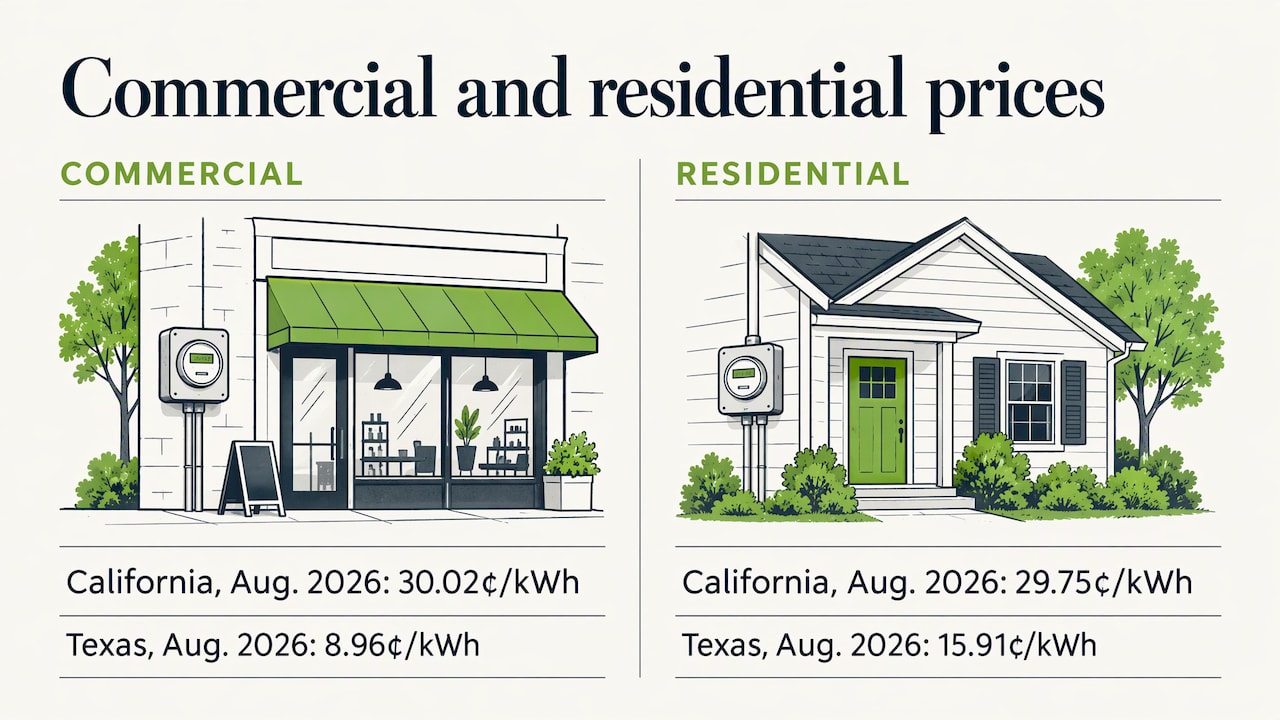
The exceptions are instructive. In August 2026, California’s commercial average was 30.02¢/kWh against 29.75¢ residential, while Texas’s commercial average was 8.96¢ against 15.91¢. Local market structure and tariffs can outweigh the general rule.
How your business electric bill is calculated
The per-kWh rate is only one line. A commercial bill typically combines several components, and the names vary by utility.
Energy charges (kWh)
Energy is the total electricity you consume, measured in kilowatt-hours. Utilities multiply it by an energy price, which can change by time of day under time-of-use plans. Southern California Edison, for example, lists customer, energy, demand, delivery, generation and several regulatory charges on a business bill.
Demand charges (kW)
Demand is how hard you draw power at your peak. The U.S. Department of Energy notes that demand charges are generally based on the customer’s highest demand in kW during the billing cycle. The U.S. Forest Service explains that demand is usually measured over a 15 or 30 minute interval, so one short spike, such as several large motors starting together, can set your charge for the whole month.
A Florida utility, LCEC, publishes demand charges from $11.00 to $20.20 per kW depending on the rate, with demand measured at the highest 15-minute interval. The rationale is that the utility must maintain capacity for brief peaks, so a customer with a low load factor costs more to serve relative to the energy it buys.
Fixed charges and adjustments
Hawaiian Electric’s commercial guide describes a bill that combines kWh times the energy price with a fixed monthly customer charge and other adjustments, including demand, power factor, voltage and fuel-recovery components.
A worked example
A 2025 New Jersey utility rate sheet shows a full calculation: for 5,000 kWh and 20 kW of demand, the stated summer charges produced a total of $980.23 after customer, generation, transmission, demand, delivery and other listed charges. Notice that the energy and demand lines are only part of the total. Your own bill will differ, but the structure is the same.
Why power factor belongs in the conversation
Most owners focus on kWh. Power factor is the quieter factor that can raise the cost of the same work.
In plain terms, the power you pay for as useful work is real power (kW). Motors, compressors, pumps and transformers also need reactive power (kVAR) to build the magnetic fields they run on. Real and reactive power combine into apparent power (kVA), the total load your wiring and the utility’s equipment must carry. Power factor is the ratio:
Power factor = real power (kW) ÷ apparent power (kVA)
Think of reactive power as a supporting actor: it does not carry the plot, but the scene cannot run without it. The closer your power factor is to 1.0, the less of your supply is spent on that supporting role.
This matters for bills. The Ohio business-bill guide explains that billing demand may differ from actual demand because of power-factor adjustments and demand-ratchet rules. Check your bill for a power factor line or a kVA demand figure. If you see one, your tariff is paying attention to it.
A business with many inductive loads, such as HVAC, refrigeration, machine shops or pumps, is the typical candidate for power factor correction.
Practical ways to lower business electricity costs
The sources agree on a short list of levers. Work through them in order of effort.
1. Read your bill and your interval data
The Department of Energy recommends reviewing utility bills and peak demand, obtaining interval data where available, checking alternative rates or providers and comparing life-cycle costs. Find your peak kW, the date and time it happened, and what set it.
2. Shift and stagger loads
Under time-variable pricing, the DOE advises shifting flexible loads to off-peak periods, staggering equipment starts and reducing nonessential peak-period operations. Starting the dishwasher, compressor and HVAC in sequence rather than together is free and can lower the demand line.
3. Review your rate schedule
The Ohio guide lists revising operating schedules, replacing inefficient equipment, selecting a different rate schedule and using efficiency or demand-response programs as ways to lower costs. LCEC adds that customers with steady 24-hour or seven-day operation may benefit from an optional rate with lower kWh charges and higher demand charges, since a higher load factor spreads capacity costs over more kWh.
4. Upgrade equipment that runs the most hours
Lighting, motors, compressors and refrigeration usually run the longest. Replacing the oldest units first gives the fastest payback, and efficient equipment also lowers your peak.
5. Improve power factor and protect equipment
Correcting power factor reduces the reactive burden on your service. Protecting equipment from surges and voltage disturbances also matters, because replacing failed motors and electronics is a cost that never appears on the utility bill. This is where we work.
Perspective: why we treat the whole electrical load, not just the meter
We built the Electric Saver 1200 around a simple idea: the electricity you pay for should do as much useful work as possible.
Many energy-saving steps focus on using less. We also look at how the power you already buy is used. Our devices are designed to recycle and optimize energy, feeding it back into the home or business, which is why we describe them as an energy saver and surge protector in one. We offer a 20-year warranty on that promise.
Our devices are UL and CuL listed, are made in the USA, and are designed for easy installation. We offer models for single-phase and three-phase systems, and they are compatible with household and business voltage up to 480V, including properties with solar panels. We state our savings target openly: up to 25% on energy costs.
For a business, we think this is the practical order of operations. Read the bill, shift what you can, choose the right rate, then add a device that works on every circuit at once, so you do not have to retrofit load by load. It also protects the appliances and motors you depend on, which can extend their working life.
Jonica
Choosing the right Electric Saver for your property
We organize our products around two kinds of customers.
- Homes and small properties: the Residential Electric Saver 1200 is designed for easy installation and whole-property surge protection.
- Commercial and three-phase sites: our Power Factor Correction Products are listed at $1,499.95 to $1,999.95 as a one-off price, and suit businesses running motors, HVAC and other inductive equipment.
- Electricians and dealers: we also offer bulk and wholesale packages for resellers and for installers working on client properties.
A quick way to pick: check whether your service is single-phase or three-phase, note the voltage (our devices are compatible up to 480V), and look at whether your bill shows a power factor or kVA line.
Ready to lower your electricity bill?
If your business bill has a demand line, a power factor adjustment or a motor-heavy load, we can help you take the next step. Our Electric Saver devices are designed to reduce energy costs by up to 25%, protect your equipment from surges and ship fast on every order. Their safety has been reviewed by UL, GE and NASA.
Browse the full range on our Electric Saver site, or go straight to the commercial power factor products.

Why costs differ so much around the world
If you operate outside the U.S., the structure is similar but the numbers are not. The World Bank notes that tariffs reflect power-sector development, service-delivery costs and subsidy policy, and that in its study of 38 Sub-Saharan African countries aggregate prices varied more than 20-fold.
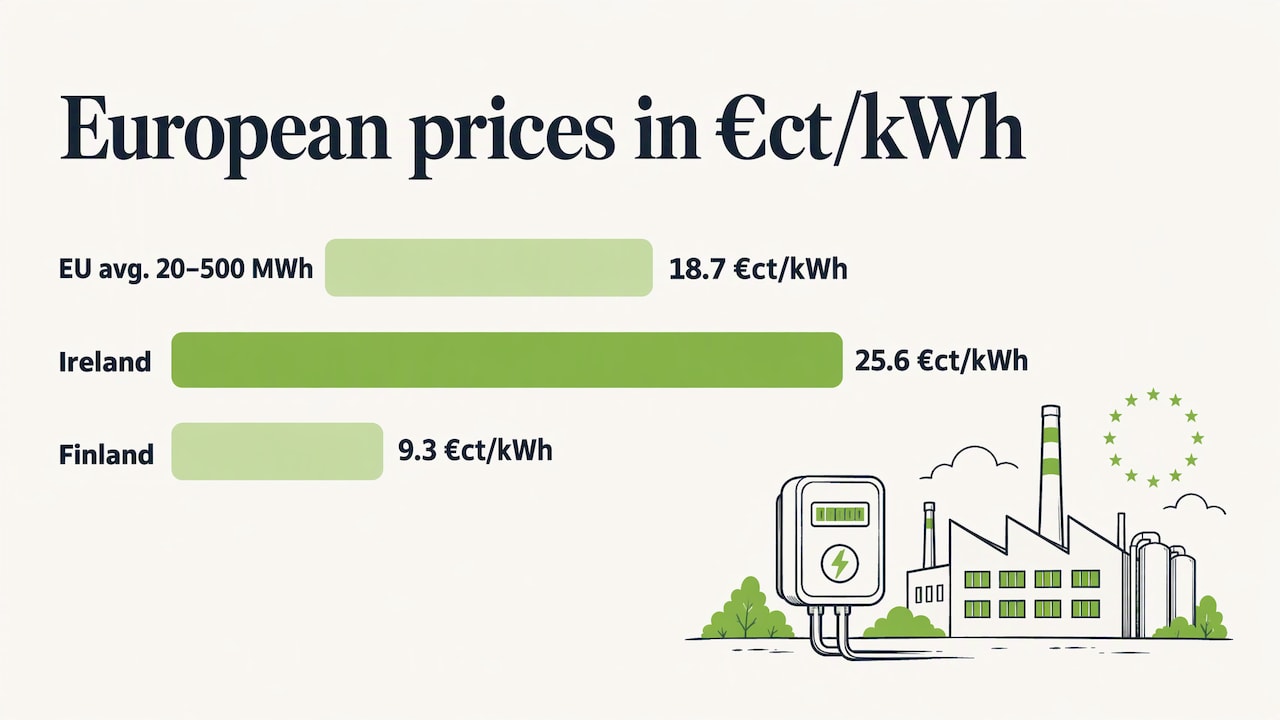
In Europe, a 2024 comparison reports an average industrial price of 18.7 euro cents/kWh for users consuming 20 to 500 MWh a year, with Ireland at 25.6 and Finland at 9.3. In the UK, the CBI says bills include wholesale energy, network, policy costs and taxes, and that most businesses pay 20% VAT, generally reclaimable. Always compare against your own local tariff, not a national headline figure.
FAQ
How much is the average electric bill for a business?
In the U.S., EIA’s 2024 data show regional averages from about $616 a month in West North Central states to $1,207 in the Pacific states. A July 2026 compilation based on EIA data puts the national average near $896. Your own bill depends on your state, tariff, hours and equipment.
Which is more expensive, commercial or residential electricity?
Nationally, residential is higher: 18.16¢/kWh against 14.47¢/kWh commercial in August 2026. Some states reverse this, with California’s commercial average slightly above its residential average. Check your own tariff.
What makes up a business electricity bill?
Typically energy charges (kWh), demand charges (kW), a fixed customer charge, delivery and generation lines, taxes and adjustments. Some utilities also adjust billing demand for power factor.
How can a business reduce electricity costs?
Start with your bill and interval data, then shift flexible loads off-peak, stagger equipment starts, review your rate schedule and upgrade the equipment that runs the most hours. Power factor correction and whole-property surge protection are further steps for sites with motors and sensitive equipment, and our Electric Saver range is designed for that.
Do Electric Saver devices work with three-phase and solar properties?
We offer models for single-phase and three-phase systems, compatible with voltage up to 480V and with properties that have solar panels. Our commercial page lists the products for business sites.
Sources
- EIA Electric Power Monthly, average retail prices
- EIA Electric Power Monthly, state data
- EIA 2024 Average Monthly Bill, Commercial
- Business Electricity Rates by State (Jul 2026)
- EIA, Prices and factors affecting prices
- EIA, Homes show greatest seasonal variation in electricity use
- Southern California Edison, Components of your Energy Bill
- U.S. Department of Energy, Federal Demand Flexibility
- U.S. Forest Service, Understanding Demand Charges
- LCEC, Demand Charges
- Hawaiian Electric, Understanding your Commercial Electric Bill
- 2025 NJ General Service Rates
- Understanding Your Utility Bill: A Guide for Businesses in Ohio
- U.S. Department of Energy, Evaluating Your Utility Rate Options
- World Bank, Electricity Tariffs for Nonresidential Customers
- Europe’s industrial electricity prices 2024
- CBI, Cutting Business Energy Costs